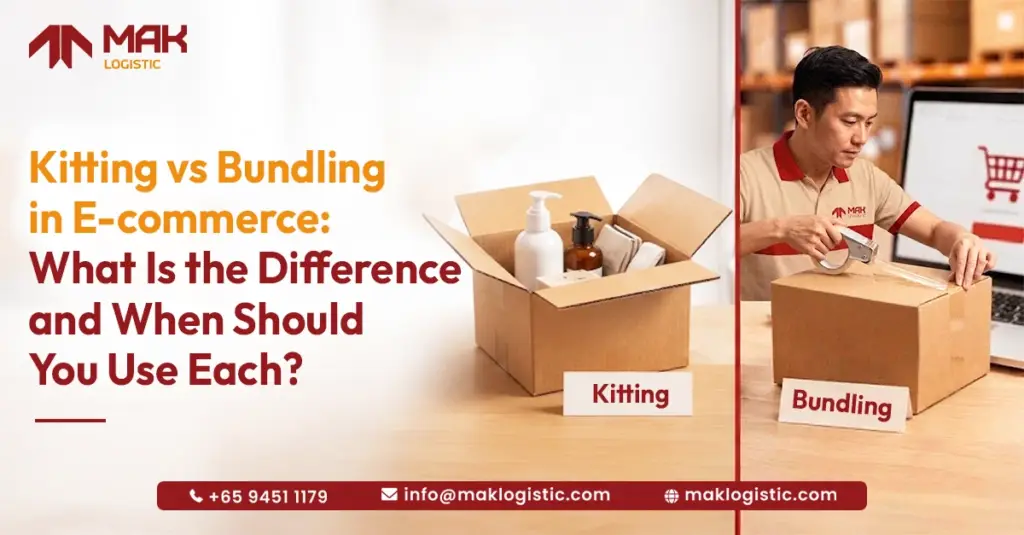
E-commerce businesses often look for ways to improve order fulfillment, simplify warehouse operations, and create a better customer experience. Two commonly used approaches are kitting and bundling.
Although the terms are sometimes used interchangeably, kitting and bundling serve different purposes. Kitting is mainly focused on preparing multiple components to be fulfilled as one unit, while bundling is generally focused on combining products into a single commercial offer.
Understanding the difference can help e-commerce businesses choose the right approach for inventory management, order fulfillment, and product sales.
For businesses operating in Singapore, working with an experienced fulfillment or 3PL provider can also make it easier to manage kitting, bundling, storage, picking, packing, and transportation as order volumes grow.
What Is Kitting in E-commerce?
Kitting is a fulfillment process where two or more individual components are grouped together and prepared as one kit for fulfillment.
For example, an online electronics store may sell a smartphone accessory kit containing:
- Phone case
- Screen protector
- Charging cable
- Cleaning cloth
Instead of picking and packing each item separately whenever an order is received, the warehouse can prepare the components as a kit in advance or during the fulfillment process.
E-commerce kitting is therefore primarily an operational activity that helps simplify order processing.
A kit may be created for a specific product, customer requirement, promotional campaign, subscription box, or seasonal offer.
What Is Bundling in E-commerce?
Bundling involves combining two or more products and selling them together as one package or offer.
For example, a skincare business could offer a:
Cleanser + Moisturizer + Sunscreen Bundle
The products may already exist as separate SKUs, but the business promotes them together as a bundle.
Unlike kitting, product bundling is often closely connected to sales and marketing strategies. Businesses may create bundles to provide convenience, encourage customers to purchase multiple products, or create special promotional offers.
The physical preparation of a bundle may also involve warehouse activities such as picking, packing, labeling, and inventory coordination.
What Is the Difference Between Kitting and Bundling?
The main difference is their purpose.
Kitting focuses on fulfillment preparation, while bundling focuses on combining products into a commercial offering.
| Kitting | Bundling |
| Combines individual components into a kit | Combines multiple products into an offer |
| Primarily a fulfillment activity | Primarily a sales and product strategy |
| Focuses on operational preparation | Focuses on product presentation and selling |
| Components may be prepared before fulfillment | Products are offered together for customers |
| Helps simplify order fulfillment | Can encourage customers to purchase multiple products |
| Often used in warehouse operations | Often used in e-commerce sales and promotions |
The two processes can also overlap. A business may create a product bundle for customers and use kitting processes in the warehouse to prepare that bundle for fulfillment.
How Does E-commerce Kitting Work?
The kitting process can vary depending on the products and fulfillment requirements. A typical process includes the following steps:
1. Identify the Kit Components
The business determines which individual products or components belong to the kit.
For example:
Product A + Product B + Product C = One Kit
2. Pick the Components
Warehouse staff locate and pick the required components from inventory.
3. Group the Products
The individual components are grouped together according to the kit specifications.
4. Pack the Kit
The components are packed together in suitable packaging.
Labels, inserts, instructions, or promotional materials may also be included.
5. Store or Fulfill the Kit
Depending on the operational model, the completed kit can be stored as a ready-to-fulfill unit or assembled when an order is received.
6. Dispatch the Order
Once an order is confirmed, the prepared kit can move through the normal fulfillment and transportation process.
This approach can reduce the number of individual picking activities required for certain orders.
When Should You Use Kitting?
Kitting can be useful when products are frequently ordered together or when several components are required to create a complete product experience.
Businesses may consider warehouse kitting services when:
- Several products are regularly purchased together
- Products need to be assembled before shipment
- Promotional kits are frequently sold
- Subscription boxes require multiple items
- Product launches require pre-assembled sets
- Seasonal gift sets need to be prepared
- Order volumes make manual preparation increasingly time-consuming
For example, a business selling home fitness products could create a starter kit containing resistance bands, a workout mat, and accessories.
Instead of treating every item as a completely separate fulfillment activity, the business can use a kitting process to prepare the complete set.
When Should You Use Bundling?
Bundling can be particularly useful when the objective is to create a more attractive product offering.
Businesses may consider product bundling in Singapore when they want to:
- Promote complementary products
- Create seasonal offers
- Increase convenience for customers
- Introduce new products alongside existing products
- Create gift sets
- Offer multiple products under one purchase option
- Encourage customers to purchase related products
For example, an online stationery store could offer a:
Notebook + Pen + Planner Bundle
Each item can remain available individually, while the bundle provides customers with a convenient purchasing option.
What Are the Benefits of Kitting for E-commerce Businesses?
Kitting can provide several operational advantages when implemented correctly.
Simplified Order Fulfillment
When frequently ordered components are prepared as a kit, warehouse teams may be able to simplify the picking and packing process.
Better Warehouse Efficiency
Organised kitting processes can help warehouse teams manage repetitive fulfillment requirements more consistently.
Faster Order Processing
Pre-prepared kits may reduce the number of individual handling activities required for certain orders.
Improved Customer Experience
Customers receive products that have already been organised as a complete set, which can make the purchasing experience more convenient.
Support for Promotional Campaigns
Businesses can create product kits for seasonal campaigns, product launches, subscription boxes, and special promotions.
What Are the Benefits of Product Bundling?
Bundling can provide both commercial and customer-focused benefits.
Greater Convenience
Customers can purchase related products together instead of searching for each product individually.
Stronger Product Offers
A carefully designed bundle can make an overall offer more attractive to customers.
Cross-Selling Opportunities
Businesses can combine complementary products to introduce customers to additional items.
Better Product Presentation
Bundles can help businesses create specific product collections for holidays, events, new customers, or particular use cases.
Flexible E-commerce Offers
Businesses can create different bundles based on customer needs, product categories, or promotional campaigns.
However, businesses should consider inventory availability and fulfillment requirements before introducing large numbers of bundles.
Can Kitting and Bundling Be Used Together?
Yes. Kitting and bundling can work together as part of an e-commerce fulfillment Singapore strategy.
Consider an online skincare company that wants to sell a “Daily Skincare Bundle.”
The business could use bundling as the commercial strategy:
Cleanser + Moisturizer + Sunscreen = Daily Skincare Bundle
The warehouse could then use kitting to group and prepare those products for fulfillment.
This creates a connection between the sales strategy and warehouse operations.
A well-coordinated process can help ensure that the products advertised online are properly reflected in inventory and fulfillment operations.
How Can a 3PL Provider Support Kitting and Bundling?
A 3PL provider can support businesses that do not want to manage every fulfillment activity internally.
Depending on the provider’s capabilities, 3PL kitting services may include:
- Receiving products
- Warehouse storage
- Inventory management
- Component picking
- Kit assembly
- Product labeling
- Packing
- Order processing
- Dispatch coordination
- Transportation
This can be particularly useful for growing e-commerce businesses that need additional warehouse capacity or operational support.
Singapore’s logistics ecosystem increasingly uses digital tools to improve visibility and operational efficiency. The Singapore Economic Development Board’s Logistics & Supply Chain Management overview provides further information about Singapore’s logistics and supply chain sector.
Businesses can also refer to the IMDA Logistics Industry Digital Plan for information on digitalisation opportunities within Singapore’s logistics industry.
How Can MAK Logistic Support E-commerce Fulfillment in Singapore?
Managing kitting and bundling internally can become more challenging as product ranges and order volumes increase.
MAK Logistic can support businesses with logistics activities such as warehouse storage, e-commerce fulfillment, warehouse manpower, transportation, and 3PL services in Singapore.
Depending on business requirements, fulfillment operations can include inventory handling, picking and packing, order preparation, and coordination with transportation.
For businesses using kitting or bundling strategies, having organised warehouse operations is important to ensure that the right products are grouped, packed, and prepared for dispatch.
Outsourcing selected logistics activities can allow businesses to focus more on sales, product development, and customer relationships while their logistics requirements are managed by an experienced partner.
Kitting vs Bundling: Which One Should Your Business Choose?
The right option depends on what your business is trying to achieve.
Choose kitting when your main objective is to:
- Simplify fulfillment operations
- Group components together
- Prepare complete product sets
- Improve warehouse handling
- Support repetitive fulfillment requirements
Choose bundling when your main objective is to:
- Create a combined product offer
- Promote complementary products
- Improve customer convenience
- Support cross-selling
- Create seasonal or promotional packages
If your business uses both strategies, the two processes can be integrated into the same fulfillment operation.
The important factor is ensuring that your warehouse inventory, order management, product information, and fulfillment processes remain aligned.
Frequently Asked Questions
What is the main difference between kitting and bundling?
Kitting is primarily a fulfillment and warehouse process used to group components together, while bundling is generally a sales strategy that combines multiple products into one commercial offer.
Is kitting useful for small e-commerce businesses?
Yes. Small e-commerce businesses can use kitting to simplify the preparation of products that are frequently sold or fulfilled together.
Can a 3PL provider handle kitting and bundling?
Yes. Some 3PL providers offer kitting, packing, inventory management, warehousing, and fulfillment services. The available services depend on the provider and the business requirements.
Does bundling reduce warehouse inventory?
Not necessarily. Bundling changes how products are offered and fulfilled, but the individual products still need to be tracked and managed in inventory.
How do I choose between kitting and bundling?
Consider your main objective. If the goal is to improve warehouse and fulfillment operations, kitting may be appropriate. If the goal is to create a combined product offer, bundling may be more suitable. Businesses can also use both approaches together.
Conclusion
Kitting and bundling may appear similar, but they serve different purposes in e-commerce.
Kitting focuses on preparing products for efficient fulfillment, while bundling focuses on combining products into an attractive customer offer.
For growing e-commerce businesses, combining the two approaches can create a more coordinated process between sales and warehouse operations.
With the right e-commerce fulfillment Singapore and 3PL support, businesses can manage inventory, kitting, bundling, order fulfillment, warehouse operations, and transportation more efficiently as their requirements grow.