
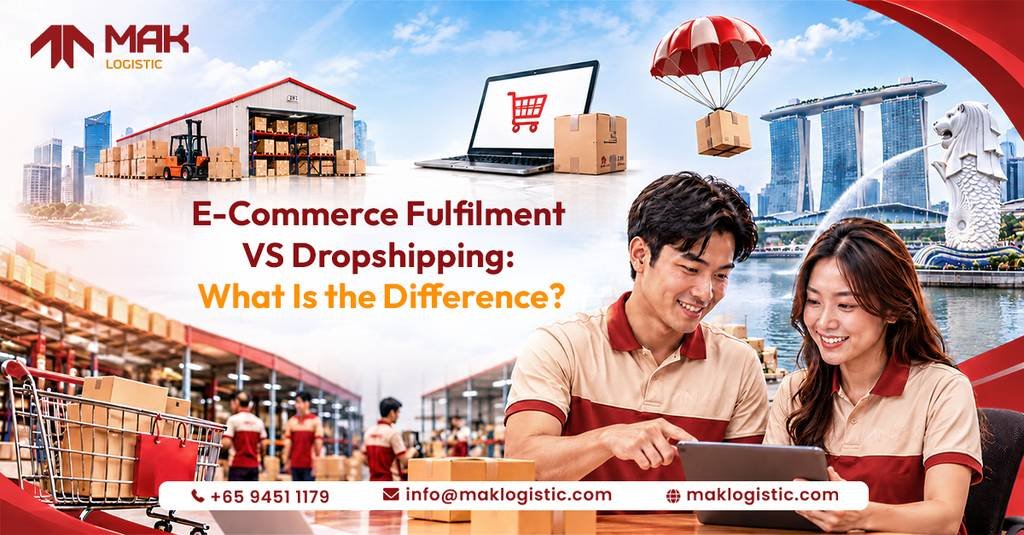
Running an online business involves more than attracting customers and receiving orders. Businesses also need a reliable way to store products, manage inventory, process orders, pack items, and arrange deliveries. Two common approaches are e-commerce fulfilment and dropshipping.
Although both methods help online businesses deliver products to customers, they operate differently. E-commerce fulfilment involves storing inventory and managing the order fulfilment process, either in-house or through a third-party logistics (3PL) provider. Dropshipping allows businesses to sell products without holding stock, as suppliers handle storage and delivery directly to customers.
Understanding the difference between e-commerce fulfilment and dropshipping can help businesses choose a suitable operating model based on their budget, product range, order volume, and growth plans.
What Is E-Commerce Fulfilment?
E-commerce fulfilment is the process of receiving, storing, processing, packing, and delivering customer orders placed through an online store.
Businesses purchase or manufacture their products and keep inventory at their own premises or in a third-party warehouse. When a customer places an order, the fulfilment team picks the correct product, packs it, prepares it for dispatch, and coordinates transportation.
A typical e-commerce fulfilment process includes:
- Inventory Receiving: Products are received from manufacturers or suppliers and recorded in the inventory system.
- Warehouse Storage: Products are organised and stored according to their type, quantity, and handling requirements.
- Order Processing: Customer orders are received and checked for accuracy.
- Picking and Packing: The correct products are picked from storage and packed for delivery.
- Dispatch and Transportation: Packed orders are prepared for collection and transported to customers.
- Returns Management: Returned products are received, inspected, and processed according to the business’s return policy.
Businesses can manage these activities internally or outsource them to an e-commerce fulfilment provider.
What Is Dropshipping?
Dropshipping is an e-commerce business model in which the seller does not purchase and store inventory in advance. Instead, the business lists products on its online store and purchases them from a supplier after receiving a customer order.
The supplier is responsible for storing the products, preparing the order, and shipping it directly to the customer.
For example, a Singapore-based online retailer may list accessories on its website without keeping them in a warehouse. When a customer places an order, the retailer forwards the details to the supplier, who packs and ships the product.
The typical dropshipping process includes:
- The seller lists products on an online store.
- A customer places an order and makes payment.
- The seller forwards the order details to the supplier.
- The supplier prepares and packs the product.
- The supplier ships the order directly to the customer.
- The seller manages customer communication and after-sales support.
The seller focuses mainly on marketing, sales, pricing, and customer service, while the supplier handles inventory and physical order processing.
E-Commerce Fulfilment vs. Dropshipping: What Are the Key Differences?
Both models support online sales, but they differ in inventory ownership, storage, order processing, delivery control, and business responsibilities.
| Comparison Factor | E-Commerce Fulfilment | Dropshipping |
| Inventory Ownership | Business purchases or owns the stock | Supplier generally owns and holds the stock |
| Warehouse Storage | Requires warehouse or storage space | Seller does not need its own warehouse |
| Order Processing | Managed in-house or by a fulfilment provider | Managed by the supplier |
| Picking and Packing | Business or 3PL provider handles the process | Supplier handles the process |
| Delivery Control | Greater control over dispatch and packaging arrangements | Depends largely on the supplier |
| Initial Investment | Usually higher due to inventory and storage costs | Generally lower because stock is not purchased upfront |
| Product Quality Checks | More direct control over stock inspection | Limited direct control before delivery |
| Branding and Packaging | More flexibility for customised packaging | Depends on supplier capabilities |
| Inventory Management | Requires stock monitoring and replenishment | Supplier manages inventory |
| Business Scalability | Can scale with suitable warehouse and fulfilment capacity | Can expand product listings without holding stock, subject to supplier capacity |
The main difference is that e-commerce fulfilment gives businesses greater involvement and control over inventory and order handling, while dropshipping reduces the need to manage physical stock.
What Are the Advantages of E-Commerce Fulfilment?
E-commerce fulfilment is suitable for businesses that want greater control over their inventory, product presentation, and customer delivery experience.
1. Better Inventory Control
Businesses can monitor stock levels, track product movement, and plan replenishment more effectively. This helps reduce stock discrepancies and avoid unnecessary delays.
2. Greater Packaging Flexibility
Businesses can customise packaging, include promotional materials, and maintain consistent branding across customer orders.
3. Improved Order Accuracy
A structured picking and packing process helps ensure that customers receive the correct products and quantities.
4. More Control Over Delivery Operations
Businesses can coordinate dispatch schedules and select suitable transportation arrangements based on delivery requirements.
5. Better Support for Business Growth
As order volumes increase, businesses can expand their storage capacity and outsource fulfilment activities to a 3PL provider instead of managing every warehouse operation internally.
What Are the Advantages of Dropshipping?
Dropshipping is often attractive to new online sellers because it reduces the need for upfront inventory investment.
1. Lower Initial Investment
Businesses do not need to purchase large quantities of products before making sales. This can reduce the financial commitment involved in starting an online store.
2. No Need to Manage Warehouse Storage
The supplier stores the products, so sellers do not need to arrange their own warehouse space or storage facilities.
3. Easier Product Testing
Online sellers can test different product categories and customer demand without purchasing substantial quantities of stock in advance.
4. Less Involvement in Physical Operations
The supplier handles product storage, picking, packing, and dispatch, allowing the seller to concentrate on marketing and customer acquisition.
5. Flexible Product Range
Sellers can offer products from different suppliers, subject to supplier availability and fulfilment arrangements.
However, dropshipping also comes with limitations. Businesses may have less control over stock availability, packaging standards, product quality, and delivery timelines.
What Are the Challenges of E-Commerce Fulfilment and Dropshipping?
Choosing either model involves certain operational considerations.
Challenges of E-Commerce Fulfilment
- Storage Expenses: Businesses need to account for warehouse space, storage duration, and handling costs.
- Inventory Investment: Purchasing stock in advance requires working capital.
- Warehouse Management: Products must be organised, tracked, and replenished properly.
- Order Management: Increasing order volumes require efficient picking, packing, and dispatch processes.
- Returns Handling: Businesses need a clear process for receiving and inspecting returned products.
These challenges can be managed through organised warehouse operations and support from a reliable fulfilment partner.
Challenges of Dropshipping
- Limited Product Control: Sellers depend on suppliers for product availability and quality.
- Supplier Dependency: Delays or operational problems at the supplier’s end can affect customer orders.
- Delivery Uncertainty: Delivery times may vary depending on supplier location and transportation arrangements.
- Lower Profit Margins: Product costs and supplier charges can reduce the seller’s profit margin.
- Branding Limitations: Custom packaging and promotional inserts may not always be available.
Businesses should carefully evaluate supplier reliability, delivery arrangements, and product quality before adopting dropshipping.
Which Model Is Better for Your E-Commerce Business?
There is no single answer because the right model depends on the business’s operational requirements and growth objectives.
E-commerce fulfilment may be suitable if:
- Your business already purchases or manufactures products in bulk.
- You want greater control over inventory and product quality.
- You require customised packaging and consistent order processing.
- You receive regular customer orders and need organised warehouse operations.
- You want to improve delivery coordination as your business grows.
Dropshipping may be suitable if:
- You are starting an online store with a limited budget.
- You want to test product demand before investing in inventory.
- You do not want to manage warehouse storage.
- Your supplier can consistently meet product quality and delivery expectations.
- You prefer to focus on marketing and sales rather than physical fulfilment operations.
Some businesses also adopt a hybrid approach. They keep fast-moving products in a warehouse for quicker fulfilment while using dropshipping for selected products with lower or uncertain demand.
How Can a 3PL Provider Support E-Commerce Fulfilment in Singapore?
As online businesses grow, managing inventory, warehouse storage, picking, packing, and transportation can become increasingly complex. Outsourcing these activities to a third-party logistics provider can help businesses improve operational efficiency.
A 3PL provider can support different stages of the e-commerce fulfilment process, including:
- Warehouse Storage: Provides organised storage space for business inventory.
- Inventory Handling: Supports stock receiving, arrangement, and movement within the warehouse.
- Order Picking and Packing: Helps prepare customer orders accurately for dispatch.
- Transportation Coordination: Arranges the movement of products from warehouses to their required destinations.
- Manpower Support: Provides warehouse manpower to assist with daily handling and fulfilment activities.
- Scalable Operations: Helps businesses manage changing storage and order-handling requirements.
For businesses in Singapore that own their inventory but do not want to manage every warehouse activity internally, working with a suitable 3PL provider can offer a more structured fulfilment arrangement.
How Does MAK Logistic Support E-Commerce Businesses?
MAK Logistic provides warehousing and logistics support for businesses in Singapore that require assistance with product storage, warehouse operations, and transportation.
Our services include warehouse storage, e-commerce fulfilment support, inventory handling, picking and packing, manpower supply, and transportation services.
Whether your business is handling regular online orders or preparing for increased order volumes, having organised warehouse and logistics support can help maintain smoother operations.
Explore our warehouse storage services in Singapore and turnkey fulfilment services to understand how MAK Logistic can support your business requirements.
Looking for reliable warehousing and fulfilment support in Singapore?
Contact MAK Logistic to discuss your business requirements.
Phone: +65 9451 1179
Email: info@maklogistic.com
Website: https://maklogistic.com/
Frequently Asked Questions
1. What is the main difference between e-commerce fulfilment and dropshipping?
E-commerce fulfilment involves storing inventory and managing order processing through the business or a logistics provider. Dropshipping allows businesses to sell products without holding stock, as the supplier handles storage and delivery.
2. Is e-commerce fulfilment more expensive than dropshipping?
E-commerce fulfilment may involve additional expenses such as inventory purchasing, warehouse storage, and order handling. Dropshipping generally requires less upfront investment, but supplier charges and product costs can affect profit margins.
3. Can a small business use a 3PL provider for e-commerce fulfilment?
Yes. Small businesses can outsource warehouse storage, inventory handling, picking, packing, and transportation to a 3PL provider. This can reduce the need to manage warehouse operations independently.
4. Can an e-commerce business use both fulfilment and dropshipping?
Yes. A hybrid model allows businesses to store selected products in a warehouse while using dropshipping for other products. This can provide flexibility when managing different product categories and customer demand.
5. Is dropshipping suitable for businesses in Singapore?
Dropshipping can be suitable for Singapore-based online sellers who want to start with lower inventory investment. However, they should evaluate supplier reliability, product quality, shipping costs, delivery timelines, and customer service responsibilities before choosing this model.
Conclusion
E-commerce fulfilment and dropshipping offer different ways to manage online orders. Dropshipping can help new sellers enter the market without investing heavily in inventory, while e-commerce fulfilment provides greater control over product storage, order processing, packaging, and delivery coordination.
The right choice depends on your business model, customer expectations, product requirements, and long-term plans. As your online business grows, organised warehousing and logistics support can help you manage increasing order volumes and maintain a consistent customer experience.
For businesses looking for e-commerce fulfilment and warehousing support in Singapore, MAK Logistic offers logistics solutions designed to support day-to-day business operations.