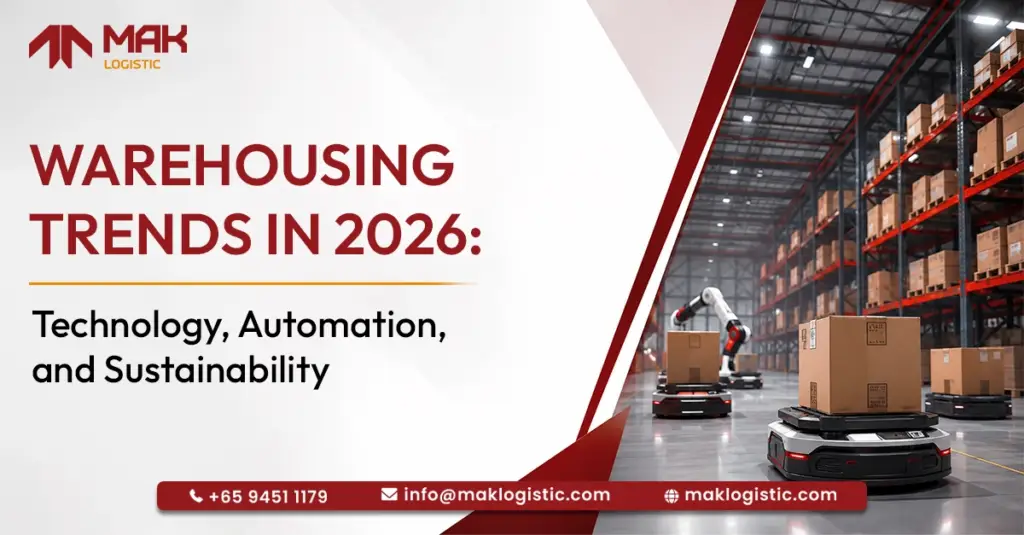
Warehousing is changing rapidly in 2026. Businesses are looking beyond basic storage and are increasingly adopting automation, artificial intelligence, real time data, smart warehouse systems, and sustainable practices to improve daily operations.
In Singapore, this shift is particularly important as logistics companies face growing demand for faster fulfillment, better inventory visibility, efficient use of warehouse space, and more sustainable operations. Enterprise Singapore highlights automation and supply chain visibility as important areas for building more agile and resilient logistics operations.
So, what are the key warehousing trends in 2026, and how can businesses prepare for the future?
What Are the Biggest Warehousing Trends in 2026?
The major warehouse trends shaping operations in 2026 include:
- Artificial intelligence and data driven warehouse management
- Automated Storage and Retrieval Systems
- Autonomous Mobile Robots
- Real time inventory visibility
- Warehouse Management Systems
- Sustainable warehouse operations
- Energy efficient facilities
- Smarter warehouse layouts
- Technology supported workforce management
- Integrated e-commerce fulfillment
These developments are helping warehouses move from traditional storage facilities to more connected and technology enabled operations.
How Is Artificial Intelligence Changing Warehouse Operations?
Artificial intelligence is becoming increasingly useful in warehouse management.
AI can analyse operational data to help businesses identify patterns, improve inventory planning, forecast demand, optimise warehouse workflows, and support better decision making.
For example, businesses can use data from warehouse management systems to understand which products move quickly, where inventory should be positioned, and when replenishment may be required.
Singapore is also actively encouraging the adoption of AI and automation across industries. Recent developments in Singapore show how robotics and AI are being integrated into logistics and manufacturing operations to improve productivity.
How Is Warehouse Automation Growing in Singapore?
Warehouse automation is one of the most important warehousing trends in Singapore.
Automation can reduce repetitive manual tasks and improve the speed and consistency of warehouse operations. Technologies being adopted include:
- Automated Storage and Retrieval Systems
- Autonomous Mobile Robots
- Automated picking systems
- Automated sorting systems
- Robotic handling systems
- Automated conveyor systems
A notable example is Maersk’s fully automated distribution centre in Singapore, which uses technologies including ASRS, Multi Shuttle Systems, Autonomous Case Handling Robots and Autonomous Mobile Robots.
This demonstrates how automation is becoming part of modern warehouse management in Singapore, particularly for large scale operations.
What Is the Role of Warehouse Management Systems in 2026?
A Warehouse Management System (WMS) is becoming an essential technology for businesses that need better control over inventory and warehouse activities.
A modern WMS can help businesses manage:
- Inventory receiving
- Stock locations
- Picking and packing
- Order processing
- Inventory movements
- Dispatch operations
- Stock levels
- Warehouse performance
Real time visibility allows businesses to understand what inventory they have, where it is stored, and when it needs to move.
Enterprise Singapore also highlights supply chain visibility as an important way for businesses to collect operational data, improve efficiency, and make better decisions.
Why Is Real Time Inventory Visibility Important?
Inventory visibility is becoming increasingly important as businesses manage larger product ranges and faster order cycles.
Without accurate inventory information, businesses may face:
- Stock discrepancies
- Overstocking
- Stockouts
- Delayed order processing
- Incorrect order fulfillment
- Poor customer experience
Real time inventory management helps businesses maintain better stock accuracy and coordinate warehouse and fulfillment activities more effectively.
For e-commerce businesses, this is particularly important because online orders can increase rapidly during promotions and peak shopping periods.
How Are Sustainable Warehouses Changing in 2026?
Sustainability is another major warehouse trend in 2026.
Businesses are increasingly looking at ways to reduce energy consumption, minimise waste, and operate warehouses more efficiently.
Sustainable warehouse practices can include:
- Energy efficient lighting
- Solar energy
- Efficient warehouse equipment
- Smart energy monitoring
- Reduced paper usage
- Sustainable packaging
- Waste reduction
- Efficient warehouse layouts
Singapore’s logistics sector is also seeing new facilities combine automation with sustainability. For example, a recently announced automated logistics facility in Singapore includes solar powered operations and other features designed to reduce energy and water use.
Can Technology Help Reduce Warehouse Energy Consumption?
Yes. Smart technology can help warehouses monitor and manage energy usage more effectively.
Businesses can use digital systems to track electricity consumption, identify inefficient equipment, and understand where energy savings may be possible.
The IMDA digital technologies for sustainability playbook also highlights the importance of collecting, integrating, and automating sustainability data so businesses can make better informed decisions.
This means sustainability is increasingly becoming a data driven process rather than simply an environmental initiative.
How Are Robots Changing Warehouse Manpower Requirements?
Automation does not necessarily mean removing people from warehouse operations. Instead, it can change the type of work employees perform.
Robots can handle repetitive or physically demanding activities, while employees can focus more on:
- Inventory control
- System monitoring
- Quality checks
- Exception management
- Warehouse planning
- Equipment supervision
Singapore’s logistics strategy also focuses on using digital technologies while supporting workforce development and job redesign.
The future warehouse is therefore likely to combine people, technology, and automation rather than relying entirely on one approach.
How Is E-Commerce Influencing Warehouse Trends?
E-commerce continues to influence how warehouses are designed and operated.
Online retailers need fast inventory processing, accurate picking and packing, flexible storage, and efficient delivery coordination.
A modern e-commerce fulfillment process can look like:
Inventory Receiving → Warehouse Storage → Order Processing → Picking → Packing → Transportation → Customer Delivery
Businesses therefore need warehouse solutions that can handle changing order volumes without creating unnecessary operational delays.
This is why e-commerce fulfillment services in Singapore are increasingly connected with warehouse management, inventory systems, transportation, and order processing.
Why Is Warehouse Layout Still Important in a Technology Driven Warehouse?
Technology alone cannot solve every warehouse challenge.
An efficient warehouse layout is still essential for reducing unnecessary movement and making better use of available storage space.
Businesses should consider:
- Product movement patterns
- Storage requirements
- Picking routes
- Loading and unloading areas
- Fast moving inventory
- Equipment movement
- Safety requirements
Combining an efficient layout with automation and warehouse management technology can create a more productive operating environment.
What Should Businesses Consider When Adopting New Warehouse Technology?
Not every business needs the same level of automation.
Before investing in technology, businesses should consider:
| Factor | What to Evaluate |
| Order volume | Current and expected order levels |
| Inventory | Product type, quantity and movement |
| Warehouse size | Available storage and operating space |
| Labour | Current manpower requirements |
| Technology | WMS, automation and integration requirements |
| Cost | Investment, maintenance and expected benefits |
| Growth | Future storage and fulfillment requirements |
The objective should not simply be to adopt the latest technology. Businesses should choose solutions that address their actual operational requirements.
What Will the Future of Warehousing in Singapore Look Like?
The warehouse of the future will likely be more automated, connected, data driven, flexible, and sustainable.
Singapore is already seeing significant investment in advanced logistics facilities. Recent developments include automated storage systems, robotics, integrated warehouse management systems, renewable energy, and energy efficient warehouse infrastructure.
For businesses, this means warehouse selection will increasingly involve more than storage capacity. Technology capabilities, inventory visibility, fulfillment support, sustainability practices, and operational flexibility will also become important considerations.
How Can Businesses Prepare for Warehousing Trends in 2026?
Businesses do not need to transform their entire warehouse overnight.
A practical approach is to start by identifying operational challenges and then introducing technology where it can deliver measurable value.
Businesses can begin by:
- Improving inventory accuracy
- Implementing a suitable WMS
- Digitising manual processes
- Reviewing warehouse layouts
- Identifying repetitive tasks suitable for automation
- Monitoring energy consumption
- Improving warehouse and transportation coordination
- Reviewing fulfillment processes regularly
This gradual approach allows businesses to adopt technology based on actual operational needs.
Why Choose MAK Logistic for Warehouse Storage in Singapore?
MAK Logistic provides warehouse storage and logistics solutions in Singapore designed to support businesses with their storage, inventory, fulfillment, and transportation requirements.
Its services include:
- Warehouse Storage
- Pallet Storage
- Racked Storage
- E-Commerce Fulfillment
- Pick and Pack Services
- Inventory Management
- Transportation Services
- 3PL Services
By combining warehouse operations with fulfillment and transportation support, businesses can manage multiple logistics requirements through a coordinated approach.
What Should Businesses Remember About Warehousing Trends in 2026?
The warehouse is no longer simply a place to store products.
In 2026, technology, automation, data visibility, sustainability, and efficient workforce management are becoming important parts of modern warehouse operations.
Businesses that understand these trends can make better decisions about warehouse technology, storage requirements, fulfillment processes, and long term logistics planning.
The goal is not to automate everything. It is to create a warehouse operation where people, technology, data, and sustainable practices work together efficiently.
Frequently Asked Questions
What are the main warehousing trends in 2026?
The major trends include warehouse automation, artificial intelligence, real time inventory visibility, Warehouse Management Systems, robotics, sustainable operations, and integrated e-commerce fulfillment.
How does automation improve warehouse operations?
Automation can reduce repetitive manual tasks, improve inventory handling, increase operational efficiency, and support faster picking, storage, and fulfillment processes.
Why is sustainability important in warehousing?
Sustainable warehousing can help businesses reduce energy consumption, minimise waste, improve resource efficiency, and support broader environmental goals.
What is the role of a Warehouse Management System?
A Warehouse Management System helps businesses manage inventory, warehouse locations, receiving, picking, packing, stock movements, and dispatch operations.
Should every business automate its warehouse?
Not necessarily. Businesses should evaluate their order volume, inventory, warehouse size, operational requirements, budget, and future growth before investing in automation.