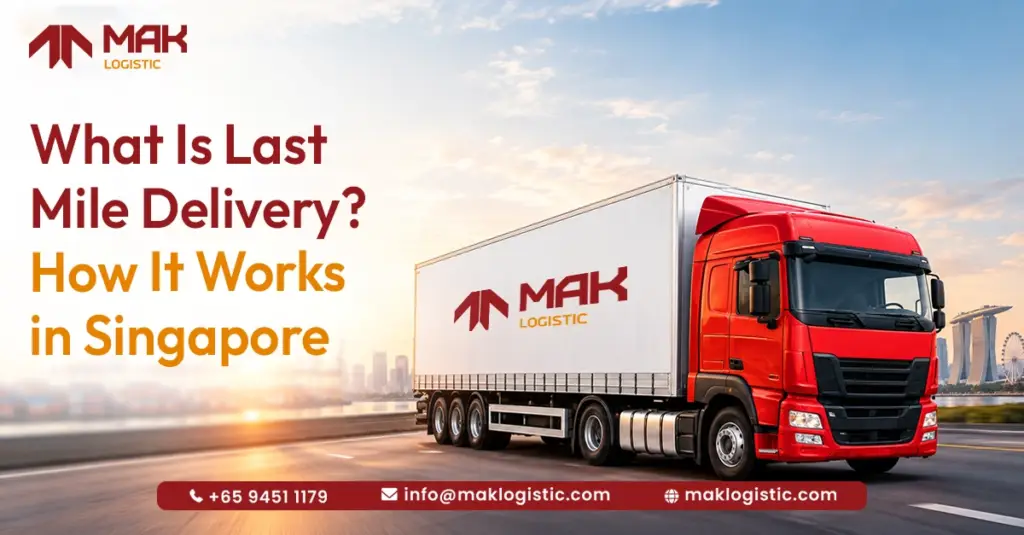
For businesses selling products in Singapore, getting goods from a warehouse to the final customer is an important part of the logistics process. This final stage is commonly known as last mile delivery.
Although it is called the “last mile,” the actual distance can be much shorter or longer. The term refers to the final movement of products from a distribution point, warehouse, or fulfillment centre to the delivery destination.
For e-commerce businesses in particular, efficient last mile delivery can influence delivery speed, customer experience, transportation costs, and overall fulfillment performance.
But how does last mile delivery work in Singapore, and what role do warehousing and logistics providers play?
What Is Last Mile Delivery?
Last mile delivery is the final stage of the logistics process where products are transported from a warehouse, distribution centre, or fulfillment location to the final delivery destination.
The destination may be:
- A customer’s home
- An office
- A retail location
- A business premises
- A collection point
- Another specified delivery address
For example, an online customer places an order through an e-commerce website. The product is stored in a warehouse, picked and packed, and then handed over for transportation. The journey from the fulfillment location to the customer’s address is the last mile delivery stage.
It is an important link between warehouse operations and customer delivery.
How Does Last Mile Delivery Work in Singapore?
Last mile delivery generally follows several connected steps.
1. Order Is Placed
The process starts when a customer places an order through an e-commerce website, marketplace, or other sales channel.
The order information is recorded and sent to the fulfillment or warehouse operation for processing.
2. Inventory Is Located
The warehouse team identifies where the ordered product is stored.
Accurate inventory management helps ensure that the correct product is available and ready for processing.
3. Picking and Packing
Warehouse workers pick the required product and prepare it for dispatch.
This may include:
- Product picking
- Quantity checking
- Packaging
- Labelling
- Order verification
Efficient picking and packing can help reduce processing delays and order errors.
4. Orders Are Prepared for Dispatch
Once orders are packed, they are organised according to delivery schedules, locations, vehicle capacity, and other transportation requirements.
Orders may be grouped based on delivery areas to improve route planning.
5. Transportation Begins
The products leave the warehouse or fulfillment facility and begin their journey to the final destination.
Depending on the business and delivery requirements, transportation may involve different vehicle types and delivery schedules.
6. Final Delivery
The driver or delivery team completes the final journey to the customer’s address or specified destination.
Once the delivery is completed, the order status can be updated to reflect successful delivery.
Why Is Last Mile Delivery Important for Singapore Businesses?
Singapore’s compact geography and highly developed transport infrastructure create opportunities for businesses to manage deliveries efficiently. However, businesses still need to coordinate inventory, warehouse operations, transportation, delivery schedules, and customer requirements.
Last mile delivery can affect several areas of business operations.
Customer Experience
Customers increasingly expect convenient and predictable delivery services. Clear delivery information and timely fulfillment can contribute to a smoother customer experience.
Logistics Costs
Transportation is an important component of the overall fulfillment cost. Efficient route planning, vehicle utilisation, and delivery scheduling can help businesses manage transportation expenses.
Order Fulfillment
A product may be correctly stored, picked, and packed, but the fulfillment process is not complete until it reaches the customer.
Business Scalability
As order volumes increase, businesses need delivery processes that can handle additional demand without creating significant delays or operational bottlenecks.
What Are the Main Challenges of Last Mile Delivery?
Last mile delivery can be one of the more complex parts of the logistics process because each order may have a different destination, delivery time, and customer requirement.
Common challenges include:
- Multiple delivery locations
- Traffic conditions
- Delivery time windows
- Failed delivery attempts
- Route planning
- Vehicle capacity
- High delivery frequency
- Customer availability
- Address accuracy
- Returns and redelivery
For e-commerce businesses with many individual orders, these challenges can become more significant as order volumes grow.
How Can Businesses Improve Last Mile Delivery in Singapore?
Businesses can take several practical steps to improve their delivery operations.
Improve Inventory Accuracy
Accurate inventory information helps ensure that orders are processed from the correct warehouse location and reduces unnecessary delays.
Organise Warehouse Operations
Efficient warehouse processes can shorten the time between receiving an order and dispatching it.
Picking, packing, labelling, and dispatch activities should work together as one coordinated process.
Plan Delivery Routes
Grouping deliveries by location and planning routes effectively can help reduce unnecessary travel and improve vehicle utilisation.
Use Appropriate Delivery Schedules
Businesses can organise deliveries according to customer requirements, order priorities, and operational capacity.
Track Delivery Performance
Businesses can monitor delivery completion, delays, failed attempts, and other operational data to identify areas for improvement.
Work With a Logistics Partner
Businesses that do not want to manage every transportation activity internally can work with a logistics provider that supports warehousing, fulfillment, and delivery operations.
What Is the Difference Between Last Mile Delivery and Transportation?
Transportation is a broader logistics activity that can cover the movement of goods between multiple locations.
For example, transportation may involve:
Supplier → Warehouse
Warehouse → Warehouse
Warehouse → Distribution Point
Warehouse → Customer
Last mile delivery specifically focuses on the final stage of the journey to the end destination.
This means last mile delivery is one part of the wider transportation and distribution process.
How Does Warehousing Support Last Mile Delivery?
A well-organised warehouse can have a direct impact on delivery efficiency.
Before a product reaches the customer, it may need to go through several warehouse activities:
Inventory receiving → Storage → Order processing → Picking → Packing → Dispatch → Delivery
If delays occur during storage, picking, packing, or dispatch, the delivery schedule can also be affected.
This is why warehouse storage in Singapore and transportation should not always be treated as separate activities. Coordinating the two can create a more connected logistics process.
How Does E-commerce Fulfillment Connect With Last Mile Delivery?
For online businesses, fulfillment covers much more than simply delivering an order.
An ecommerce fulfillment service in Singapore may include:
- Warehouse storage
- Inventory management
- Order processing
- Picking and packing
- Product handling
- Dispatch preparation
- Transportation coordination
- Returns processing
Last mile delivery forms the final connection between these fulfillment activities and the customer.
When fulfillment and transportation are properly coordinated, businesses can reduce unnecessary delays between order processing and delivery.
Can 3PL Services Support Last Mile Delivery?
Yes. Third-party logistics providers can help businesses coordinate several parts of the logistics process.
Depending on the service arrangement, 3PL services in Singapore may include:
- Warehouse storage
- Inventory management
- Picking and packing
- E-commerce fulfillment
- Transportation
- Distribution
- Warehouse manpower
- Returns handling
Using a 3PL provider can allow businesses to combine warehousing and transportation requirements instead of managing every logistics activity independently.
This can be particularly useful for growing e-commerce businesses that need flexible logistics support as order volumes change.
What Role Does Technology Play in Last Mile Delivery?
Technology can help businesses improve visibility and coordination across delivery operations.
Depending on the logistics setup, businesses may use technology for:
- Order tracking
- Inventory visibility
- Route planning
- Delivery status updates
- Digital proof of delivery
- Transportation monitoring
- Performance reporting
Better visibility can help warehouse and transportation teams coordinate more effectively and identify delivery issues sooner.
However, technology works best when it supports well-defined warehouse and transportation processes.
How Can MAK Logistic Support Transportation and Fulfillment?
MAK Logistic provides logistics solutions for businesses operating in Singapore, including transportation services, warehouse storage, e-commerce fulfillment, warehouse manpower, and 3PL services.
For businesses managing regular deliveries, MAK Logistic can support the logistics activities that connect inventory storage and fulfillment with transportation.
Its services can help businesses coordinate areas such as:
- Warehouse storage
- Inventory handling
- Picking and packing
- E-commerce fulfillment
- Transportation
- Warehouse manpower
- 3PL logistics support
By connecting warehouse and transportation activities, businesses can create a more organised flow from inventory storage to final delivery.
Frequently Asked Questions
1. What is last mile delivery?
Last mile delivery is the final stage of the logistics process, where products are transported from a warehouse, fulfillment centre, or distribution location to the final delivery destination.
2. Why is last mile delivery important for e-commerce?
Last mile delivery connects the fulfillment process with the customer. Efficient delivery can help businesses manage delivery schedules, transportation costs, and customer expectations.
3. How does last mile delivery work in Singapore?
The process typically involves order processing, inventory allocation, picking and packing, dispatch preparation, transportation, route planning, and final delivery to the customer’s address or designated location.
4. What is the difference between transportation and last mile delivery?
Transportation refers broadly to moving goods between locations, while last mile delivery specifically refers to the final stage of delivering products to the end destination.
5. Can a 3PL provider manage last mile delivery?
A 3PL provider can support transportation and distribution as part of a broader logistics service. Depending on the arrangement, this may also include warehouse storage, inventory management, fulfillment, picking and packing, and manpower support.
Conclusion
Last mile delivery is the final connection between a business’s logistics operation and its customer.
In Singapore, businesses can improve this process by coordinating warehouse storage, inventory management, picking and packing, transportation, route planning, and delivery operations.
For growing e-commerce and product-based businesses, integrating warehousing and transportation can provide greater visibility and help create a more organised fulfillment process.
MAK Logistic supports businesses with warehouse storage, transportation, e-commerce fulfillment, manpower supply, and 3PL services in Singapore.
Looking for transportation and fulfillment support in Singapore?
📞 +65 9451 1179
📧 info@maklogistic.com
🌐 maklogistic.com
#LastMileDelivery #LastMileDeliverySingapore #TransportationSingapore #EcommerceFulfillmentSingapore #WarehouseStorageSingapore #3PLSingapore #LogisticsSingapore #MAKLogistic