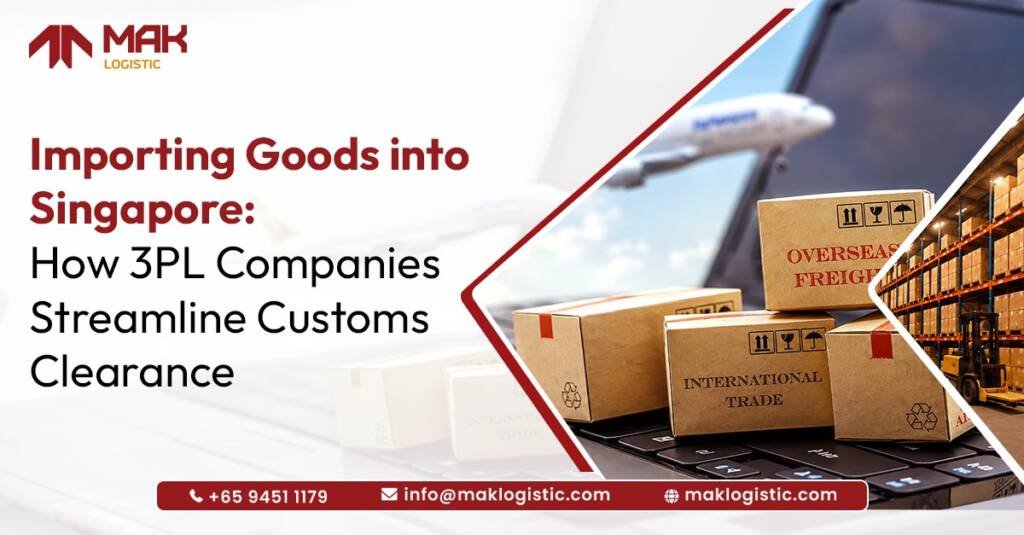
Importing goods into Singapore involves more than simply arranging transportation. Businesses need to manage import permits, customs declarations, supporting documents, duties and GST, controlled goods requirements, and the movement of products after clearance.
For businesses handling regular imports, working with a 3PL company in Singapore can make the process more organised by connecting customs clearance with transportation, warehousing, inventory management, and distribution.
So, how does the import process work, and how can a 3PL provider help businesses manage customs clearance more efficiently?
What Does Customs Clearance Mean When Importing Goods into Singapore?
Customs clearance is the process of completing the required customs procedures before imported goods can be released for use or onward movement in Singapore.
Depending on the type of goods and shipment, businesses may need to provide information such as:
- Commercial invoice
- Packing list
- Bill of lading or airway bill
- Import permit
- Product and shipment details
- Relevant approvals for controlled goods
Singapore Customs requires import permits to be submitted through TradeNet, Singapore’s National Single Window for trade declarations. Businesses can appoint a declaring agent to apply for customs permits on their behalf.
What Are the Key Steps When Importing Goods into Singapore?
The import process generally involves several connected activities.
| Step | What Happens |
| 1. Product preparation | Product and shipment information is prepared |
| 2. Documentation | Commercial invoice, packing list and transport documents are checked |
| 3. Product classification | Applicable HS codes and control requirements are reviewed |
| 4. Import permit | Required declaration is submitted through TradeNet |
| 5. Customs assessment | Customs and relevant authorities review the declaration |
| 6. Clearance | Approved goods can proceed through the relevant checkpoint |
| 7. Delivery | Goods are transported to the warehouse or final destination |
The exact requirements can vary depending on the nature of the goods, their origin, value, and whether they are controlled or dutiable.
Why Is Import Documentation Important for Singapore Customs Clearance?
Accurate documentation is essential because customs declarations depend on the information provided about the imported goods.
Incorrect or incomplete information can result in additional checks, delays, or the need to correct documentation.
A 3PL provider can help businesses organise the required shipping and trade documents before the shipment arrives. This creates a more structured process between the importer, supplier, freight forwarder, customs declaring agent, warehouse, and transportation team.
Singapore Customs also advises businesses to check whether their goods are controlled by a Competent Authority before importing them.
How Does a 3PL Company Help With Customs Clearance?
A Third Party Logistics Provider in Singapore can coordinate several activities involved in the import process.
Depending on the services offered, a 3PL company may support businesses with:
- Import documentation coordination
- Customs declaration support
- Transportation arrangements
- Warehouse receiving
- Inventory management
- Storage
- Order fulfillment
- Distribution
Businesses can therefore manage customs related activities together with their broader logistics operations instead of coordinating every stage separately.
What Is the Role of a Declaring Agent in Singapore?
A declaring agent can submit customs permit applications through TradeNet on behalf of an importer.
Singapore Customs states that businesses can appoint a declaring agent to apply for customs permits on their behalf.
This can be particularly useful for businesses that regularly import goods but do not have an internal team experienced in handling customs declarations.
A 3PL or logistics provider may work with or provide access to the appropriate customs declaration support as part of a broader logistics arrangement.
How Does a 3PL Provider Reduce Import Delays?
Import delays can occur when documentation, permits, product information, or approvals are not prepared correctly.
A structured logistics process can help reduce avoidable delays by ensuring that:
- Shipment details are collected before arrival.
- Required documents are reviewed.
- Product requirements are identified.
- Applicable permits are prepared.
- Transportation is coordinated with clearance.
- Goods are moved to the warehouse after release.
For businesses with regular shipments, having one logistics partner coordinate these activities can improve communication between different parties.
What Happens When Imported Goods Require Additional Approval?
Some goods may be subject to controls administered by Singapore’s Competent Authorities.
Businesses should check the applicable requirements before importing such products. Singapore Customs provides an HS and Competent Authority product code search to help importers identify whether goods are controlled.
If approval is required, the relevant documentation or approval should be obtained according to the applicable requirements before the goods are imported.
A logistics provider can help coordinate the required information and supporting documents, while the importer remains responsible for meeting the applicable regulatory requirements.
How Does Customs Clearance Connect With Warehousing?
Customs clearance is only one stage of the import process.
Once goods are cleared, businesses may need to move them to a warehouse for storage, inventory processing, or order fulfillment.
A typical process can look like:
Supplier → International Transportation → Singapore Customs Clearance → Warehouse Storage → Inventory Management → Order Fulfillment → Customer Delivery
This is where integrated warehousing and logistics services in Singapore can provide additional value.
Instead of arranging customs, transportation, warehouse storage, and delivery separately, businesses can coordinate these activities through a connected logistics operation.
Why Is Warehouse Storage Important After Customs Clearance?
Imported goods often need to be stored before they are distributed to customers, retailers, or other business locations.
A suitable warehouse storage solution in Singapore can help businesses manage:
- Incoming inventory
- Stock quantities
- Product locations
- Order processing
- Picking and packing
- Dispatch
- Distribution
This is particularly useful for importers, wholesalers, retailers, manufacturers, and e-commerce businesses that receive products from overseas suppliers.
How Can 3PL Services Benefit E-Commerce Importers?
E-commerce businesses may import products in bulk and distribute them across multiple customer orders.
A 3PL provider can connect the import process with e-commerce fulfillment in Singapore, allowing imported inventory to move from clearance to storage and then into the fulfillment process.
For example:
Import → Customs Clearance → Warehouse Storage → Inventory Update → Online Order → Pick and Pack → Transportation → Customer
This approach can help businesses maintain better inventory visibility while reducing the need to manage every logistics activity separately.
What Should Businesses Look for in a 3PL Provider for Importing Goods?
Businesses should evaluate more than the storage capacity of a logistics provider.
Important factors include:
| Factor | What to Consider |
| Customs support | Experience with import documentation and declarations |
| Transportation | Ability to coordinate inbound and outbound movement |
| Warehouse | Suitable storage capacity and security |
| Inventory | Inventory tracking and stock management |
| Fulfillment | Picking, packing and order processing capabilities |
| Communication | Clear coordination between stakeholders |
| Industry experience | Familiarity with the business and product requirements |
Choosing a provider with multiple connected services can make import and distribution operations easier to coordinate.
How Can Businesses Prepare for a Smooth Import Process?
Businesses can take several steps before their shipment arrives in Singapore.
1. Prepare Accurate Product Information
Make sure product descriptions, quantities, values, and other shipment details are accurate.
2. Organise Trade Documents
Keep commercial invoices, packing lists, bills of lading or airway bills, and other relevant documents ready.
3. Check Import Requirements
Determine whether the products are controlled, dutiable, or subject to additional requirements.
4. Plan Transportation
Arrange transportation from the relevant checkpoint to the warehouse or final destination.
5. Prepare Warehouse Space
Ensure that the receiving warehouse has sufficient capacity for the incoming inventory.
6. Coordinate With Your 3PL Provider
Share shipment information early so the logistics team can coordinate the required activities.
Why Is an Integrated Logistics Approach Important for Importers?
Importing goods involves several connected stages. A delay at one stage can affect the activities that follow.
For example, if customs documentation is incomplete, clearance may be delayed. If warehouse receiving is not prepared, cleared goods may not move efficiently into storage. If transportation is not coordinated, additional waiting time may occur.
An integrated logistics approach connects these activities and improves communication between the different teams involved.
This is one reason businesses choose 3PL services in Singapore for their import, storage, fulfillment, and transportation requirements.
Why Choose MAK Logistic for Logistics Services in Singapore?
MAK Logistic provides integrated logistics services in Singapore to support businesses with warehouse storage, transportation, fulfillment, and 3PL requirements.
Its services include:
- Warehouse Storage
- Pallet Storage
- Racked Storage
- E-Commerce Fulfillment
- Pick and Pack Services
- Transportation Services
- Inventory Management
- 3PL Services
By combining warehousing, fulfillment, and transportation services, MAK Logistic helps businesses coordinate their logistics operations after goods arrive in Singapore.
What Should Businesses Remember About Importing Goods into Singapore?
Importing goods into Singapore requires proper planning, accurate documentation, appropriate permits, and coordination between multiple logistics activities.
A 3PL company in Singapore can help businesses streamline the process by connecting customs clearance support with transportation, warehousing, inventory management, fulfillment, and distribution.
The goal is not simply to clear goods through customs. It is to create a smooth process from international shipment to warehouse storage and final delivery.
Businesses should always verify the latest import requirements directly with Singapore Customs and the relevant Competent Authorities, as requirements can vary depending on the products being imported.
Frequently Asked Questions
What documents are required when importing goods into Singapore?
Common documents include a commercial invoice, packing list, bill of lading or airway bill, import permit, and other supporting documents depending on the type of goods and applicable requirements.
What is TradeNet in Singapore?
TradeNet is Singapore’s National Single Window for trade declarations. Import and export permit applications are submitted through TradeNet.
Can a 3PL company help with customs clearance?
Yes. A 3PL provider can coordinate customs related documentation and declaration support while also managing transportation, warehousing, inventory, and fulfillment activities.
What happens after customs clearance?
After clearance, goods can be transported to a warehouse or another approved destination for storage, inventory management, fulfillment, or distribution.
Why should importers use a 3PL provider?
A 3PL provider can combine transportation, warehouse storage, inventory management, fulfillment, and logistics coordination, helping businesses manage their import operations through a more connected process.