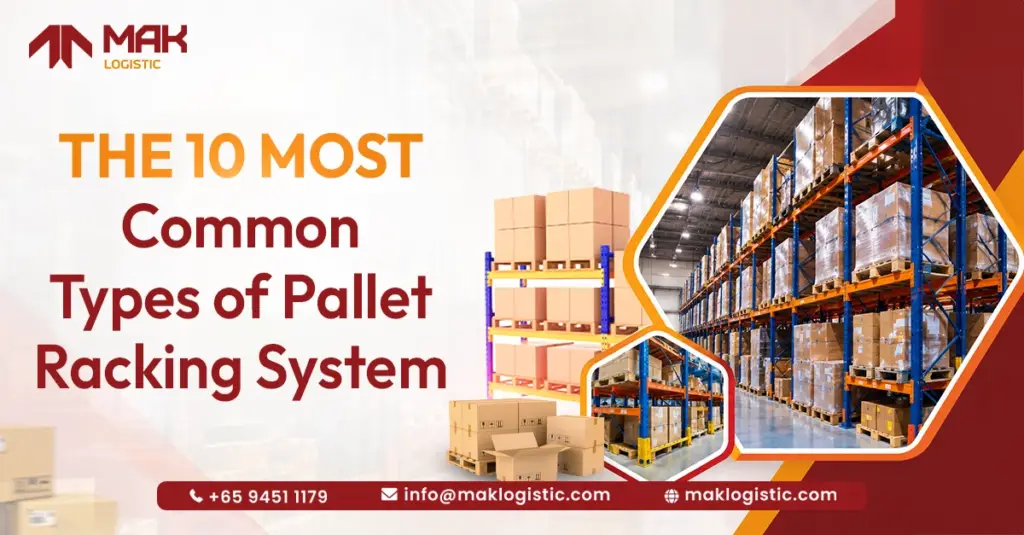
Pallet racking is one of the most widely used storage solutions in warehouses. It allows businesses to organise palletised products vertically, improve warehouse space utilisation, and make inventory easier to access.
However, not every pallet racking system is suitable for every warehouse. The right choice depends on factors such as available space, pallet size, inventory turnover, product characteristics, accessibility requirements, and storage volume.
For businesses looking for warehouse storage in Singapore, understanding the different types of pallet racking systems can help when planning warehouse layouts and storage requirements.
In this guide, we explain the 10 most common types of pallet racking systems, how they work, and where each system can be used.
What Is a Pallet Racking System?
A pallet racking system is a warehouse storage structure designed to store goods on pallets across multiple vertical levels.
Instead of placing every pallet directly on the warehouse floor, racking allows businesses to use the available vertical space.
A typical pallet racking system consists of:
- Upright frames
- Horizontal beams
- Pallet support components
- Safety accessories
- Row and aisle configurations
The exact design depends on the type of racking system and the warehouse’s operational requirements.
Pallet racking is commonly used in manufacturing, wholesale, retail, e-commerce, distribution, and third-party logistics operations.
What Are the 10 Most Common Types of Pallet Racking Systems?
The most common pallet racking systems include:
- Selective pallet racking
- Drive-in pallet racking
- Drive-through pallet racking
- Double-deep pallet racking
- Push-back pallet racking
- Pallet flow racking
- Very Narrow Aisle (VNA) racking
- Mobile pallet racking
- Cantilever racking
- Mezzanine-supported or multi-tier racking
Each system has a different design and is suited to different warehouse requirements.
1. Selective Pallet Racking
Selective pallet racking is one of the most common pallet storage systems.
It provides direct access to individual pallets from warehouse aisles. Each pallet position can generally be accessed without moving other pallets.
Key characteristics:
- Direct access to pallets
- Easy inventory management
- Suitable for different SKU types
- Flexible configuration
- Relatively simple loading and unloading
Selective racking is particularly useful when a warehouse stores many different products and requires regular access to individual pallets.
When is selective pallet racking suitable?
It can be suitable for businesses that prioritise inventory accessibility and flexibility rather than maximum storage density.
It is commonly used in distribution centres, wholesale warehouses, manufacturing facilities, and 3PL warehouses.
2. Drive-In Pallet Racking
Drive-in pallet racking is designed for high-density storage.
Forklifts can enter the racking structure to place and retrieve pallets. Because the system uses fewer aisles, more warehouse floor space can be dedicated to storage.
Key characteristics:
- High storage density
- Reduced aisle space
- Forklift access into storage lanes
- Suitable for large quantities of similar products
Drive-in racking is often suitable for businesses storing relatively large quantities of the same or similar products.
What is the limitation of drive-in racking?
Because pallets are stored within the same lane, access to individual pallets can be more limited compared with selective racking.
This makes product rotation and SKU variety important considerations when selecting this system.
3. Drive-Through Pallet Racking
Drive-through pallet racking is similar to drive-in racking, but the storage lanes can be accessed from both ends.
This allows forklifts to enter from one side and exit from the other.
Key characteristics:
- High-density storage
- Access from both ends
- Improved movement through storage lanes
- Suitable for larger quantities of similar products
Drive-through racking can be useful when warehouse operations require better movement through storage lanes or when a first-in, first-out approach is important.
4. Double-Deep Pallet Racking
Double-deep pallet racking allows pallets to be stored two positions deep rather than one.
This can increase storage capacity while maintaining more accessibility than some high-density systems.
Key characteristics:
- Increased storage density
- Two pallets stored in depth
- Fewer aisles compared with standard selective racking
- Requires suitable forklift equipment
Double-deep racking can be useful for warehouses that need additional storage density but still require relatively regular access to inventory.
One consideration is that the pallet at the front may need to be moved before accessing the pallet behind it.
5. Push-Back Pallet Racking
Push-back pallet racking uses inclined rails or carts that allow pallets to be stored several positions deep.
When a new pallet is loaded, it pushes the existing pallet further into the lane. When a pallet is removed, the remaining pallets move forward.
Key characteristics:
- High-density storage
- Multiple pallets stored in depth
- Reduced aisle requirements
- Good use of vertical space
- Faster loading and retrieval compared with some other dense-storage systems
Push-back racking can be suitable for warehouses handling multiple pallets of the same product while still requiring access to different product lanes.
6. Pallet Flow Racking
Pallet flow racking uses rollers or wheels to move pallets through storage lanes.
Pallets are typically loaded from one side and retrieved from another, supporting a first-in, first-out inventory approach.
Key characteristics:
- FIFO-friendly design
- High-density storage
- Controlled pallet movement
- Separate loading and picking sides
- Useful for products requiring stock rotation
Pallet flow racking can be particularly useful for food and beverage, pharmaceutical, and other operations where inventory rotation is important.
For businesses managing products with expiry dates, a suitable stock rotation system can help support better inventory control.
7. Very Narrow Aisle (VNA) Racking
Very Narrow Aisle racking is designed to maximise warehouse storage capacity by reducing the width of forklift aisles.
Specialised equipment is generally required to operate safely within these narrower spaces.
Key characteristics:
- High space utilisation
- Narrow operating aisles
- High vertical storage
- Direct pallet access
- Requires suitable material handling equipment
VNA systems can be useful when warehouse floor space is limited and the business wants to make greater use of vertical space.
However, warehouse layout, equipment requirements, and operational processes need to be carefully planned.
8. Mobile Pallet Racking
Mobile pallet racking is installed on movable bases that can travel along rails.
Instead of maintaining permanent aisles between every rack, the system can open an aisle where access is required.
Key characteristics:
- High storage density
- Reduced fixed aisle space
- Flexible access
- Efficient use of warehouse floor area
- Suitable for space-constrained warehouses
Mobile racking can be considered when storage capacity is important and the warehouse needs to make better use of available floor space.
It can be especially useful where warehouse space is expensive or limited.
9. Cantilever Racking
Cantilever racking is designed for storing long, bulky, or irregularly shaped products that may not fit easily on conventional pallet racks.
The system uses horizontal arms extending from vertical columns.
Common applications include:
- Pipes
- Timber
- Metal bars
- Long panels
- Furniture
- Construction materials
Cantilever racking is different from standard pallet racking because it does not rely on conventional front-to-back pallet positions.
For businesses handling long products, it can provide more practical access and organisation.
10. Mezzanine-Supported or Multi-Tier Racking
Multi-tier racking systems use vertical warehouse space to create multiple storage or working levels.
A mezzanine structure can be integrated into the warehouse layout to create additional usable space.
Key characteristics:
- Makes use of vertical space
- Creates additional storage levels
- Can support manual picking operations
- Useful for warehouses with high ceilings
- Can increase usable warehouse area without expanding the building footprint
Multi-tier systems can be particularly useful for businesses handling smaller products that are picked manually rather than stored exclusively as full pallets.
The design needs to account for structural requirements, access, safety, and warehouse operations.
How Do You Choose the Right Pallet Racking System?
There is no single pallet racking system that works for every warehouse.
The right choice depends on several factors.
1. What Type of Products Are You Storing?
Consider:
- Product dimensions
- Product weight
- Pallet size
- Product packaging
- Product handling requirements
- Storage conditions
Standard palletised products may work well with selective or high-density pallet racking, while long products may require cantilever racking.
2. How Frequently Do You Access Inventory?
Inventory turnover is an important consideration.
If individual pallets need to be accessed frequently, selective racking may provide greater accessibility.
If large quantities of the same product are stored for longer periods, high-density systems such as drive-in or push-back racking may be more appropriate.
3. Do You Need FIFO or LIFO?
Inventory rotation requirements can influence the racking system.
FIFO — First In, First Out: Older inventory is generally moved out before newer inventory.
LIFO — Last In, First Out: The most recently stored inventory may be retrieved first.
Pallet flow systems can support FIFO operations, while some drive-in configurations are more suited to LIFO-style storage.
The actual inventory process should be designed around the product and operational requirements.
4. How Much Warehouse Space Is Available?
Warehouse floor area and ceiling height both matter.
A warehouse with high ceilings may be able to use vertical storage more effectively.
Businesses with limited floor space may consider systems such as:
- VNA racking
- Mobile racking
- Double-deep racking
- Push-back racking
The objective is not simply to install more racks but to create a layout that balances storage capacity, accessibility, safety, and workflow.
5. What Material Handling Equipment Do You Use?
Different racking systems may require different equipment.
Examples include:
- Counterbalance forklifts
- Reach trucks
- Narrow-aisle equipment
- Pallet trucks
- Specialised warehouse equipment
The rack design and material handling equipment should work together to maintain safe and efficient warehouse operations.
What Are the Benefits of Pallet Racking?
A properly planned pallet racking system can provide several warehouse benefits.
Better use of vertical space
Racking allows businesses to store products vertically rather than relying only on floor-level storage.
Improved inventory organisation
Clearly defined pallet locations can make inventory easier to identify and manage.
Better warehouse accessibility
The appropriate racking system can make loading and retrieval more systematic.
Increased storage capacity
High-density systems can allow businesses to store more pallets within the available warehouse area.
Improved workflow
A well-designed warehouse layout can help reduce unnecessary movement between storage, picking, packing, and dispatch areas.
What Should Businesses Consider Before Installing Pallet Racking?
Before selecting a pallet racking system, businesses should assess the complete warehouse operation.
Important considerations include:
- Warehouse dimensions
- Ceiling height
- Pallet dimensions
- Maximum pallet weight
- Number of SKUs
- Inventory turnover
- Required accessibility
- FIFO or LIFO requirements
- Forklift specifications
- Aisle requirements
- Loading and unloading processes
- Safety requirements
- Future storage requirements
The objective should be to select a system that supports the entire warehouse workflow rather than focusing only on storage capacity.
Pallet Racking and Warehouse Storage in Singapore
Warehouse space is an important consideration for businesses operating in Singapore.
Companies managing inventory may need to balance storage capacity with accessibility, handling requirements, and operational efficiency.
A suitable warehouse storage in Singapore solution can include pallet storage, inventory handling, order fulfillment, transportation, and other logistics services depending on the business requirement.
For businesses that do not want to operate their own warehouse, working with a logistics or 3PL provider can provide access to warehouse infrastructure and operational support.
How Can MAK Logistic Support Warehouse Storage?
MAK Logistic provides warehouse storage and logistics services in Singapore for businesses that need flexible storage and operational support.
Depending on business requirements, warehouse operations can include:
- Pallet storage
- Warehouse storage
- Inventory handling
- Picking and packing
- Order fulfillment
- Transportation
- E-commerce fulfillment
- Warehouse manpower support
- 3PL logistics services
Businesses can evaluate their product type, inventory volume, storage duration, and fulfillment requirements to determine the most appropriate warehouse solution.
Frequently Asked Questions
1. What is the most common type of pallet racking?
Selective pallet racking is one of the most widely used systems because it provides direct access to individual pallets and can accommodate different product types.
2. Which pallet racking system provides the highest storage density?
High-density systems such as drive-in, drive-through, push-back, and mobile racking can provide greater storage density than conventional selective racking. The most suitable option depends on the warehouse layout and inventory requirements.
3. What pallet racking is suitable for FIFO inventory?
Pallet flow racking is commonly associated with FIFO inventory management because pallets can be loaded from one side and retrieved from another.
4. What is the difference between selective and drive-in pallet racking?
Selective racking generally provides direct access to individual pallets, while drive-in racking stores pallets deeper within storage lanes to increase storage density.
5. How do I choose the right pallet racking system?
Consider your product type, pallet dimensions, inventory turnover, storage density, accessibility, warehouse dimensions, material handling equipment, and inventory rotation requirements before selecting a system.
Conclusion
Pallet racking plays an important role in organising warehouse inventory and making better use of available storage space.
The 10 common pallet racking systems covered in this guide include selective, drive-in, drive-through, double-deep, push-back, pallet flow, VNA, mobile, cantilever, and multi-tier racking.
Each system has different strengths and applications. The right choice depends on the products being stored, inventory movement, available space, equipment, and operational requirements.
For businesses looking for warehouse storage in Singapore, evaluating the complete storage and logistics operation can help create a solution that supports both current requirements and future growth.
Looking for warehouse storage and logistics support in Singapore?
MAK Logistic provides warehouse storage, inventory handling, e-commerce fulfillment, transportation, manpower supply, and 3PL services.
📞 +65 9451 1179
📧 info@maklogistic.com
🌐 maklogistic.com
#PalletRacking #PalletRackingSystems #WarehouseStorage #WarehouseStorageSingapore #WarehouseManagement #WarehouseSolutions #WarehouseRacking #LogisticsSingapore #3PLSingapore #InventoryManagement #MAKLogistic