

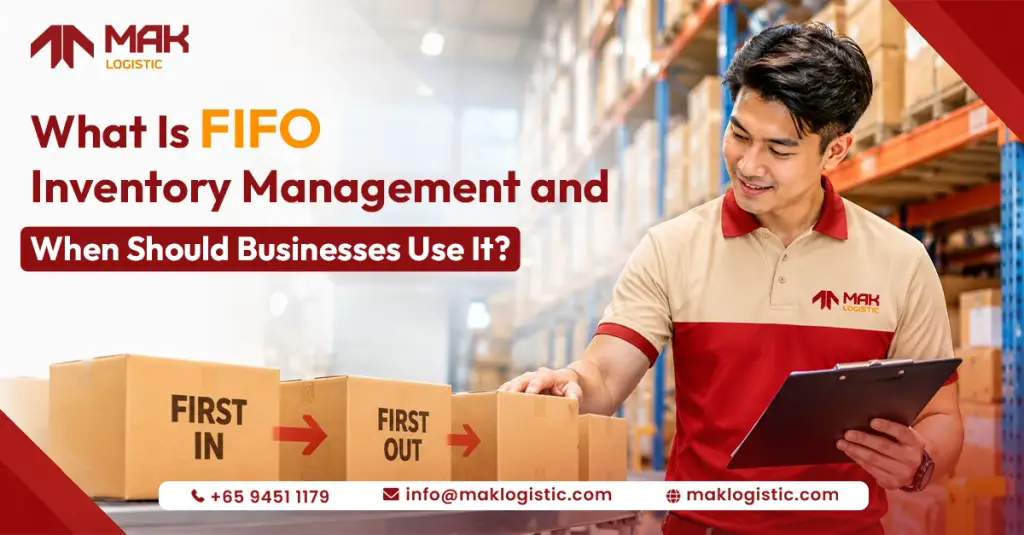
Managing inventory is not just about knowing how many products are available in a warehouse. Businesses also need to ensure that stock is stored, organised, monitored, and issued in the correct order. Without an effective inventory rotation system, older products can remain unused while newer stock is picked and dispatched first. This can lead to stock ageing, product deterioration, unnecessary waste, and higher inventory management costs.
One practical solution is FIFO inventory management.
FIFO, which stands for First In, First Out, is an inventory management method where the products received first are issued, used, or dispatched before newer stock. It helps businesses maintain an organised warehouse, improve stock rotation, and reduce the risk of products remaining in storage for too long.
For businesses managing warehouse storage, e-commerce fulfilment, wholesale distribution, food products, and general inventory in Singapore, understanding how FIFO works can support better warehouse operations.
In this guide, we explain what FIFO inventory management means, how it works, its benefits, when businesses should use it, and how to implement an effective FIFO inventory system.
What Is FIFO Inventory Management?
FIFO inventory management is a stock rotation method that follows the principle of First In, First Out. Under this approach, the inventory received earliest is picked, used, or dispatched before products received more recently.
The purpose is to prevent older inventory from remaining unused while newer products are moved out first.
For example, imagine a warehouse receives three batches of the same product:
| Batch | Stock Received | Quantity |
| Batch A | 1 November | 100 units |
| Batch B | 5 November | 150 units |
| Batch C | 10 November | 200 units |
If a customer places an order for 120 units, the warehouse team should first pick all 100 units from Batch A, followed by 20 units from Batch B.
This ensures that the earliest-received inventory moves out first.
FIFO inventory management is particularly useful for businesses that handle products with a limited shelf life, changing packaging, seasonal demand, or regular stock replenishment.
Important distinction: FIFO can refer to both physical stock rotation and an accounting method used to calculate inventory costs. This article focuses primarily on physical inventory rotation in warehouse operations. The accounting treatment should be considered separately based on the applicable financial reporting requirements.
How Does the FIFO Inventory Management Method Work?
A successful FIFO inventory system requires more than simply placing older products at the front of a shelf. Businesses need consistent receiving, labelling, storage, picking, and stock monitoring procedures.
Here is how the FIFO inventory management process works.
1. Receive and Inspect Incoming Inventory
When products arrive at the warehouse, employees should verify the received quantities against purchase orders, delivery documents, and supplier records.
The team should also inspect the products for visible damage, incorrect quantities, and other receiving discrepancies.
2. Record the Stock Receiving Date
Every incoming batch should have a clearly recorded receiving date. Depending on the product, businesses may also need to record batch numbers, manufacturing dates, expiry dates, and other identification details.
Accurate receiving records help warehouse teams identify which inventory arrived first.
3. Label and Organise Products
Products should be labelled with relevant identification details and placed in designated storage locations.
Older stock should be positioned so that it can be accessed and picked before newer stock. Warehouse layouts should support this movement without creating unnecessary handling difficulties.
4. Follow FIFO During Order Picking
When a customer order is received, warehouse employees should identify the oldest available stock of the required product.
The picking process should follow the recorded receiving sequence rather than selecting whichever stock is easiest to access.
5. Update Inventory Records
After products are picked and dispatched, the inventory system should be updated to reflect the remaining quantities.
Accurate stock records help businesses track inventory movement and identify discrepancies between physical stock and recorded quantities.
6. Conduct Regular Stock Audits
Businesses should periodically review stock locations, receiving dates, product condition, and inventory records.
Regular checks help identify products that have remained in storage for longer than expected and allow corrective action before stock becomes obsolete or unsuitable for sale.
What Are the Benefits of FIFO Inventory Management?
Implementing a FIFO inventory management system can improve warehouse organisation and support better inventory control. Here are eight important benefits.
1. Reduces the Risk of Old Stock Accumulation
When businesses follow FIFO, older inventory is prioritised for picking and dispatch. This reduces the possibility of older products remaining unused while newly received stock continues to move.
It is especially useful for businesses that manage regularly replenished inventory.
2. Helps Minimise Product Waste
Products that remain in storage for extended periods may become damaged, outdated, or unsuitable for sale.
FIFO helps businesses rotate stock more systematically, reducing the risk of avoidable inventory waste. For products with expiry dates, however, businesses should check whether FEFO is more appropriate.
3. Improves Warehouse Organisation
FIFO encourages businesses to maintain clear storage locations, receiving records, and stock movement procedures.
An organised FIFO warehouse makes it easier for employees to identify available inventory and follow consistent picking practices.
4. Supports Better Inventory Visibility
Recording receiving dates and stock movements gives businesses a clearer understanding of inventory age and availability.
This helps warehouse managers identify older batches, monitor stock movement, and plan replenishment more effectively.
5. Improves Order Fulfilment Operations
When inventory is organised according to FIFO, warehouse employees can follow a more consistent picking process.
This supports order fulfilment activities by reducing confusion over which stock should be selected for dispatch.
6. Helps Manage Storage Costs
Inventory that remains unused for long periods occupies warehouse space and may increase storage-related expenses.
FIFO helps move older stock through the warehouse in a planned sequence, supporting better utilisation of available storage capacity.
7. Supports Product Quality Management
For products where age and storage duration affect quality, FIFO helps businesses prioritise older stock for movement.
However, FIFO alone does not guarantee product quality. Appropriate storage conditions, handling procedures, inspection, and product-specific controls are also essential.
8. Makes Inventory Tracking More Consistent
A properly implemented FIFO inventory system creates a clear process for recording stock receipt, storage, picking, and dispatch.
This improves operational consistency and helps businesses identify where inventory handling procedures need improvement.
When Should Businesses Use FIFO Inventory Management?
FIFO is useful for many businesses, but it is particularly suitable when stock age, product condition, or inventory rotation matters.
1. Food and Beverage Businesses
Food manufacturers, distributors, supermarkets, and food suppliers regularly handle products that require careful stock rotation.
FIFO helps move older received stock first. However, for products with different expiry dates, businesses should use FEFO (First Expired, First Out) to prioritise the earliest-expiring usable stock.
The National Environment Agency (NEA) recommends FIFO and FEFO stock rotation practices in its food waste minimisation guidance for food retailers and manufacturers.
2. E-Commerce Businesses
Online retailers often receive regular stock replenishments from suppliers. Without a proper inventory rotation method, older products may remain in storage while newly received products are picked for customer orders.
FIFO helps e-commerce warehouse teams organise inventory and maintain a consistent order-picking process.
3. Wholesale and Distribution Businesses
Wholesalers and distributors may manage large quantities of similar products across multiple batches.
FIFO helps warehouse employees identify older inventory and follow a consistent stock dispatch sequence.
4. Pharmaceutical and Healthcare Product Distribution
Healthcare-related products may have strict expiry, batch tracking, and storage requirements.
For products with expiry dates, FEFO is often more appropriate than relying on receipt date alone. Businesses should follow the applicable product-specific storage, traceability, and distribution requirements.
5. Manufacturing Businesses
Manufacturers use different raw materials, components, and packaging supplies in their production processes.
FIFO can help move older received materials into production first, provided they remain suitable for use and meet the required quality specifications.
6. Electronics and Consumer Goods
Electronics and consumer products may not always have traditional expiry dates, but they can become outdated as newer models and product versions enter the market.
FIFO can help businesses manage older batches and maintain a more organised stock rotation process. Product condition, serial numbers, and batch identification should still be considered.
FIFO vs FEFO vs LIFO: What Is the Difference?
FIFO is not the only inventory rotation method. Businesses may also use FEFO or LIFO depending on the type of products they store and their operational requirements.
| Method | Full Form | Stock Selection Rule | Suitable Applications |
| FIFO | First In, First Out | Oldest received stock moves first | General inventory, retail, e-commerce and warehouse stock |
| FEFO | First Expired, First Out | Stock with the earliest expiry date moves first | Food, beverages and expiry-sensitive products |
| LIFO | Last In, First Out | Most recently received stock moves first | Limited operational situations where the storage and product characteristics support it |
FIFO vs FEFO
The main difference between FIFO and FEFO is the date used to decide which inventory should move first.
FIFO follows the receiving date, whereas FEFO follows the expiry date.
For example:
- Batch A arrives on 1 November and expires on 30 December.
- Batch B arrives on 5 November and expires on 20 December.
Under FIFO, Batch A moves first because it arrived earlier.
Under FEFO, Batch B moves first because it expires earlier.
This distinction is important for food suppliers, manufacturers, and businesses handling products with limited shelf lives.
For a more detailed explanation, read our related article on FIFO vs FEFO vs LIFO: Which Stock Rotation Method Should Your Business Use?.
When Should Businesses Choose FIFO or FEFO?
Choose FIFO when the receiving sequence is the main consideration and expiry dates do not override that sequence.
Choose FEFO when products have expiry dates and the earliest-expiring suitable batch must be used or dispatched first.
Businesses handling different product categories may need to use both methods within the same warehouse.
How Can Businesses Implement an Effective FIFO Inventory System?
Introducing FIFO requires proper warehouse planning, employee awareness, and accurate inventory records.
The following practices can help businesses implement FIFO more effectively.
1. Establish Clear Stock Rotation Procedures
Create standard operating procedures that explain how incoming inventory should be received, labelled, stored, picked, and dispatched.
Employees should understand which products need FIFO and which require FEFO or another product-specific handling method.
2. Use Clear Inventory Labelling
Labels should contain the relevant product identification information, receiving date, batch number, and expiry date where applicable.
Clear labelling makes it easier for warehouse employees to identify the correct stock during picking.
3. Arrange Suitable Warehouse Storage Locations
Warehouse shelves and racks should be organised to support the movement of older stock before newer stock.
Businesses can use designated receiving, storage, picking, and dispatch areas to maintain an orderly inventory flow.
4. Maintain Accurate Inventory Records
A warehouse management system (WMS) or suitable inventory management software can help record stock quantities, receiving dates, storage locations, and inventory movements.
Businesses with smaller operations can begin with structured inventory records, provided that updates are consistent and stock movements are regularly checked.
5. Train Warehouse Employees
Warehouse employees should understand FIFO procedures and know how to identify older inventory.
Training should cover receiving checks, stock labelling, storage arrangement, order picking, and inventory record updates.
6. Monitor Slow-Moving Inventory
Businesses should regularly review products that remain in storage for extended periods.
Slow-moving stock reports can help identify products that need attention, promotional planning, replenishment adjustments, or other inventory decisions.
7. Conduct Regular Inventory Audits
Physical stock checks should be compared with warehouse records to identify missing, misplaced, damaged, or incorrectly recorded inventory.
Businesses should investigate discrepancies and update their procedures where necessary.
What Are the Common FIFO Inventory Management Mistakes Businesses Should Avoid?
Even with a defined FIFO policy, mistakes can occur when warehouse procedures are not followed consistently.
Some common problems include:
- Incorrect Stock Labelling: Missing receiving dates make it difficult to identify the oldest stock.
- Poor Storage Arrangement: New stock may block access to older inventory.
- Inaccurate Inventory Records: Unrecorded stock movements can affect FIFO picking decisions.
- Inconsistent Picking Procedures: Employees may select convenient stock rather than the oldest available batch.
- Insufficient Staff Training: Employees may not understand how FIFO should be applied to different product categories.
- Ignoring Expiry Dates: Following FIFO without checking expiry dates can be unsuitable for products with different shelf lives.
To avoid these mistakes, businesses should combine proper warehouse organisation with clear procedures, accurate records, and regular monitoring.
How Can a Logistics Provider Support FIFO Inventory Management in Singapore?
Managing FIFO inventory requires coordinated warehouse activities, including stock receiving, labelling, storage, picking, packing, and dispatch.
For businesses handling large quantities of products, these activities can become difficult to manage without suitable warehouse space, trained manpower, and organised inventory procedures.
A third-party logistics (3PL) provider can support businesses with different stages of warehouse operations, including:
- Warehouse Storage: Organised storage arrangements for business inventory.
- Inventory Handling: Support for receiving, arranging, and moving products within the warehouse.
- Picking and Packing: Assistance with preparing orders for dispatch.
- Warehouse Manpower: Additional workforce support for daily warehouse activities.
- Transportation Coordination: Support for moving products between warehouses and required destinations.
- E-Commerce Fulfilment: Assistance with warehouse activities involved in processing online orders.
Businesses should confirm that their chosen logistics provider can follow the required stock rotation procedures and maintain the inventory records needed for their products.
How Does MAK Logistic Support Warehouse and Inventory Operations?
MAK Logistic provides warehousing and logistics support for businesses in Singapore that require organised storage, inventory handling, and fulfilment assistance.
Our services include:
- Warehouse storage services.
- E-commerce fulfilment support.
- Inventory handling and warehouse operations.
- Picking and packing support.
- Warehouse manpower supply.
- Transportation services.
For businesses implementing FIFO inventory management, organised warehouse operations and consistent stock-handling procedures are important for maintaining better inventory movement.
MAK Logistic can discuss your warehouse storage and logistics requirements and help identify suitable operational support.
Explore our services:
- Warehouse Storage Services in Singapore
- 3PL Services in Singapore
- Turnkey Fulfilment Services
- Warehouse Manpower Supply in Singapore
- How 3PL Providers Improve Coordination Between Warehousing and Transportation
Looking for warehouse storage and logistics support in Singapore?
Contact MAK Logistic to discuss your business requirements.
Phone: +65 9451 1179
Email: info@maklogistic.com
Website: https://maklogistic.com/
Frequently Asked Questions About FIFO Inventory Management
1. What does FIFO mean in inventory management?
FIFO stands for First In, First Out. It is an inventory rotation method where the oldest received stock is picked, used, or dispatched before newer inventory.
2. Why is FIFO important in warehouse management?
FIFO helps businesses maintain organised stock rotation, reduce the risk of old inventory accumulation, improve stock visibility, and support consistent warehouse picking procedures.
3. Which industries should use FIFO inventory management?
FIFO is commonly used in e-commerce, retail, wholesale distribution, manufacturing, food distribution, and general warehousing. Businesses should consider product shelf life and handling requirements when selecting a rotation method.
4. What is the difference between FIFO and FEFO inventory management?
FIFO prioritises stock based on its receiving date, while FEFO prioritises stock based on its expiry date. FEFO is particularly important for products with different expiry dates.
5. Can a warehouse management system support FIFO?
Yes. A warehouse management system can record receiving dates, batch details, storage locations, and stock movements. Depending on the system configuration, it can help warehouse teams identify and select the oldest eligible inventory first.
6. Does FIFO help reduce warehouse storage costs?
FIFO can help improve stock movement and reduce the time older products remain in storage. However, actual storage cost savings depend on inventory levels, warehouse space, storage duration, and operational efficiency.
7. Is FIFO suitable for products without expiry dates?
Yes. FIFO can be useful for products without expiry dates when businesses want to maintain a consistent stock rotation sequence and reduce the risk of older inventory becoming outdated or obsolete.
Conclusion
FIFO inventory management is a practical method for businesses that need better control over stock rotation and warehouse operations. By prioritising older received inventory, companies can improve stock organisation, reduce the risk of ageing inventory, and support more consistent order fulfilment.
However, FIFO should be applied according to product requirements. Businesses handling expiry-sensitive products may need FEFO, while other inventory categories can follow FIFO.
With proper labelling, organised warehouse storage, accurate inventory records, and trained employees, businesses can establish a more reliable stock management process.
For companies in Singapore looking for warehouse storage, inventory handling, and fulfilment support, MAK Logistic can help coordinate the logistics activities that support day-to-day warehouse operations.


