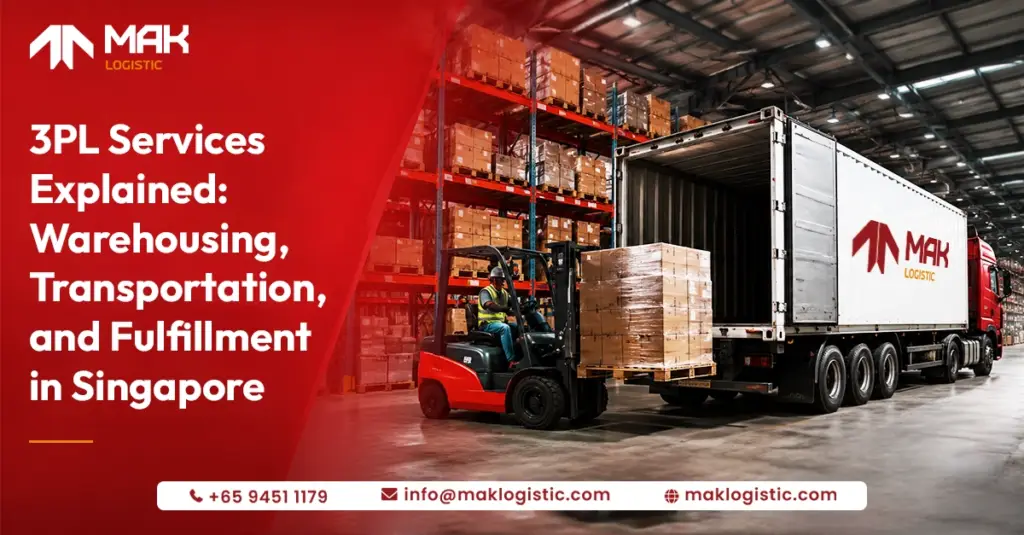
Managing logistics internally can become challenging as a business grows. Companies may need to store inventory, process orders, arrange transportation, prepare shipments, and coordinate deliveries at the same time. Managing each activity separately can lead to communication gaps, delayed dispatches, inventory issues, and additional operational work.
This is where 3PL services in Singapore can help.
Third-party logistics providers manage or coordinate logistics activities on behalf of businesses. Depending on business requirements, these services can include warehousing, inventory management, order fulfillment, picking, packing, transportation, and delivery coordination.
Singapore is an important logistics and supply chain hub, supported by strong connectivity and infrastructure. The Singapore Economic Development Board (EDB) describes Singapore as a major logistics and supply chain management hub with a strong ecosystem of third-party logistics providers.
But what exactly does a 3PL provider do, and how do warehousing, transportation, and fulfillment work together?
What Are 3PL Services?
3PL stands for third-party logistics.
A 3PL provider is an external logistics partner that manages selected supply chain activities for a business. Instead of handling every logistics function internally, a company can outsource specific operations to a specialist provider.
Depending on the business model, third party logistics services can include:
- Warehouse storage
- Inventory management
- Product receiving
- Order processing
- Picking and packing
- Order fulfillment
- Transportation
- Dispatch coordination
- Delivery support
The exact combination of services depends on the company’s products, order volumes, storage requirements, delivery locations, and operational needs.
For example, an e-commerce business may use a 3PL provider to store inventory, process customer orders, pick and pack products, and coordinate transportation.
How Do 3PL Services Work in Singapore?
A 3PL operation connects several logistics activities into one workflow:
Products Received → Inventory Stored → Order Received → Products Picked → Orders Packed → Transportation Arranged → Products Dispatched → Delivery Completed
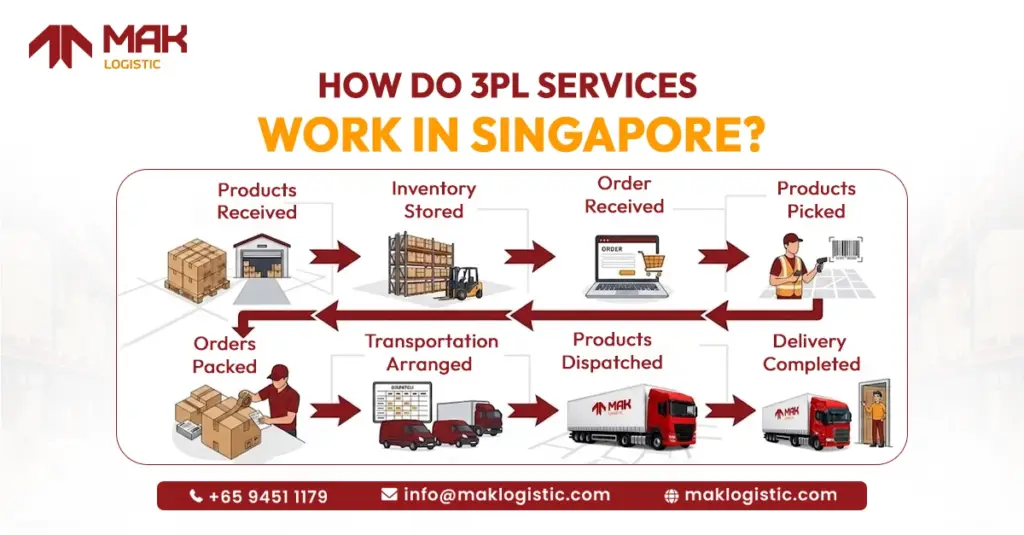
Instead of coordinating each stage separately, a business can work with one logistics partner to manage or connect these activities.
For example, once an order is received, the warehouse team can check inventory, pick the required products, pack the order, and prepare it for dispatch. The transportation team can then arrange collection and delivery according to the planned schedule.
This creates a more connected logistics process.
Singapore’s logistics industry is also focusing on technology, supply chain visibility, and efficient information flow. Enterprise Singapore highlights digitalisation and supply chain visibility as important areas for improving logistics operations and decision-making.
What Does 3PL Warehousing Include?
Warehousing is one of the main components of many 3PL solutions.
3PL warehousing Singapore services can cover the receiving, storage, handling, and preparation of products before they are fulfilled or distributed.
Typical warehouse activities include:
Product Receiving
Products arriving at the warehouse can be received, checked, and recorded before being placed into storage.
Inventory Storage
Products can be stored according to their type, volume, handling requirements, and expected movement.
Inventory Management
Accurate inventory information helps businesses understand available stock and plan replenishment.
Picking
When an order is received, warehouse staff retrieve the required products from their storage locations.
Packing
Picked products are packed according to order requirements before dispatch.
Dispatch Preparation
Completed orders are organised and prepared for collection or delivery.
Businesses may require different storage solutions depending on their products, including short-term storage, long-term storage, pallet storage, racked storage, or e-commerce warehouse storage.
How Does Warehouse Storage Support Business Operations?
Warehouse storage is not simply about keeping products in a physical location. It also needs to support inventory control and order processing.
For example, an e-commerce seller may have hundreds of products stored in a warehouse. When an order is placed, the warehouse team needs to locate the correct products, pick them accurately, pack the order, and prepare it for dispatch.
A well-organised warehouse process connects these activities with fulfillment and transportation.
For businesses that do not operate their own warehouse, outsourcing storage and warehouse operations can reduce the need to manage warehouse infrastructure and day-to-day activities internally.
What Are 3PL Transportation Services?
Warehousing is only one part of logistics. Products also need to move between locations.
3PL transportation services help businesses coordinate the movement of products from warehouses to customers, retailers, distributors, or other business locations.
Transportation activities can include:
- Vehicle scheduling
- Collection coordination
- Loading
- Delivery planning
- Local transportation
- Warehouse-to-warehouse transportation
- Airport-to-warehouse transportation
- Delivery coordination
Transportation planning needs to consider order volume, delivery locations, product requirements, vehicle capacity, and delivery schedules.
When transportation is connected with warehouse operations, vehicles can be scheduled according to when products are ready for dispatch. This can help reduce unnecessary waiting and improve the movement of products from warehouse to destination.
What Is 3PL Fulfillment?
Fulfillment is the process of receiving, processing, and completing customer orders.
For many businesses, particularly e-commerce companies, fulfillment includes:
Order Received → Inventory Checked → Picking → Packing → Dispatch → Transportation → Delivery
Fulfillment services Singapore businesses use can include inventory storage, order processing, picking, packing, dispatch preparation, and transportation coordination.
For example, when a customer places an order through an online store, the warehouse team can receive the order information, identify the required products, pick them, pack the order, and prepare it for transportation.
This allows the business to focus on sales, marketing, and customer service while the logistics provider handles the physical order process.
Singapore continues to attract investment in logistics and e-commerce fulfillment. In March 2026, EDB reported the opening of a 1.1 million-square-foot automated logistics hub in Singapore by Maersk, designed to support regional distribution and e-commerce fulfillment.
How Do Warehousing, Transportation, and Fulfillment Work Together?
The main advantage of 3PL is the ability to connect different logistics functions.
Warehousing stores and manages inventory.
Fulfillment moves products from inventory through picking, packing, and dispatch.
Transportation moves completed orders to their destinations.
Together, the process can look like:
WAREHOUSING
Inventory received and stored
↓
FULFILLMENT
Orders picked, packed, and prepared
↓
TRANSPORTATION
Products collected and delivered
When these activities are coordinated, businesses can have better visibility into the movement of products from storage to delivery.
This also reduces the need to coordinate separately with multiple logistics partners.
What Are the Benefits of Using 3PL Services in Singapore?
Businesses can benefit from 3PL services in several ways.
1. Simplified Logistics Management
A 3PL provider can coordinate multiple logistics activities, reducing the number of separate operational tasks managed internally.
2. Access to Warehouse Infrastructure
Businesses can use professional storage facilities without establishing and managing their own warehouse.
3. More Efficient Order Fulfillment
A structured picking, packing, and dispatch process can help orders move through the warehouse more efficiently.
4. Better Transportation Coordination
Warehouse operations can be connected with vehicle scheduling and delivery requirements.
5. Improved Inventory Visibility
Businesses can receive clearer information about inventory and order processing.
6. Support During Business Growth
A 3PL provider can support changing storage, fulfillment, and transportation requirements as order volumes change.
7. More Focus on Core Business
Outsourcing logistics can allow internal teams to focus on sales, marketing, product development, and customer service.
Enterprise Singapore also highlights the importance of supply chain visibility, technology, and efficient logistics processes for the Singapore logistics sector.
Which Businesses Can Benefit From 3PL Services?
3PL solutions can support businesses across different industries, including:
- E-commerce
- Retail
- FMCG
- Food suppliers
- Electronics
- Semiconductor
- Healthcare
- Manufacturing
- Wholesalers and distributors
For example, an e-commerce business may require inventory storage, order fulfillment, and last-mile transportation, while a manufacturer may require warehouse storage and regular transportation between locations.
The appropriate 3PL solution depends on the company’s products, inventory volume, order frequency, and distribution requirements.
How Can 3PL Services Support E-Commerce Businesses?
E-commerce businesses often need to process multiple individual orders while maintaining accurate inventory and timely deliveries.
A 3PL provider can support the complete fulfillment workflow:
Inventory Storage → Order Processing → Picking → Packing → Dispatch → Transportation → Delivery
This means an online seller does not necessarily need to operate its own warehouse or manage every delivery activity.
Instead, the logistics provider can handle the physical movement of inventory while the business focuses on its online store, products, marketing, and customers.
How Do 3PL Services Support Supply Chain Management?
Supply chain management involves coordinating the movement of products, information, and resources from suppliers through to customers.
A 3PL provider can become an important operational link by managing activities such as storage, fulfillment, transportation, and delivery.
A coordinated logistics process can provide businesses with better visibility into:
- Inventory levels
- Warehouse movements
- Order status
- Dispatch schedules
- Transportation activities
- Delivery progress
Singapore’s logistics ecosystem continues to develop around connectivity, digitalisation, and supply chain capabilities. EDB notes that Singapore has strong air and sea connectivity and a broad ecosystem of logistics and supply chain companies.
Why Is Singapore Important for 3PL Services?
Singapore’s strategic location and logistics infrastructure make it an important hub for businesses operating in Singapore and across the Asia-Pacific region.
The country has strong sea and air connectivity and hosts many leading logistics and supply chain companies. EDB also identifies the presence of major third-party logistics providers as part of Singapore’s logistics ecosystem.
For businesses operating in Singapore, a local 3PL provider Singapore can help coordinate storage, fulfillment, transportation, and distribution requirements.
What Should You Consider When Choosing a 3PL Provider in Singapore?
Choosing a 3PL provider involves more than comparing storage or transportation prices.
Businesses should consider:
Warehouse Capabilities
Does the provider offer appropriate storage options for your products and inventory volume?
Fulfillment Capabilities
Can the provider handle picking, packing, order processing, and dispatch?
Transportation Services
Does the provider offer transportation solutions that match your delivery requirements?
Inventory Visibility
How will your business receive information about stock levels and warehouse movements?
Communication
How will your business communicate with warehouse and transportation teams?
Industry Experience
Does the provider understand your product and industry requirements?
Service Flexibility
Can the provider accommodate changes in storage, order volumes, or transportation requirements?
A suitable 3PL partner should provide clear processes and communication across the logistics operation.
How Does MAK Logistic Provide 3PL Services in Singapore?
MAK Logistic provides logistics solutions for businesses in Singapore, supporting warehousing, storage, fulfillment, and transportation requirements.
Our services include:
- 3PL services
- Warehouse storage
- Warehouse services
- E-commerce fulfillment
- Pick and pack services
- Pallet storage
- Racked storage
- Transportation services
- Warehouse-to-warehouse transportation
- Airport-to-warehouse transportation
By connecting warehousing, fulfillment, and transportation, MAK Logistic helps businesses manage their logistics requirements through a coordinated process.
Whether your business requires warehouse storage, e-commerce fulfillment, or transportation support, MAK Logistic can help you identify a logistics solution based on your operational requirements.
Frequently Asked Questions About 3PL Services
What services does a 3PL provider offer?
A 3PL provider may offer warehouse storage, inventory management, picking, packing, order fulfillment, transportation, dispatch coordination, and delivery services.
What is the difference between 3PL and fulfillment?
Fulfillment focuses mainly on processing and completing customer orders, including picking, packing, and dispatch. 3PL is broader and can include fulfillment together with warehousing, inventory management, transportation, and other logistics activities.
Can a 3PL provider manage warehousing and transportation?
Yes. A 3PL provider can coordinate warehouse storage and operations with transportation scheduling, collection, and delivery.
Are 3PL services suitable for small businesses?
Yes. Small and growing businesses can use 3PL services to outsource logistics activities instead of investing in their own warehouse and transportation infrastructure.
How do I choose a 3PL provider in Singapore?
Consider warehouse capabilities, fulfillment services, transportation coverage, inventory visibility, communication, industry experience, and the provider’s ability to support your storage and order requirements.
Conclusion
3PL services bring together important logistics activities, including warehousing, transportation, and fulfillment.
Instead of managing each function separately, businesses can work with a third-party logistics provider to coordinate inventory storage, order processing, picking, packing, dispatch, transportation, and delivery.
For businesses operating in Singapore, this approach can simplify logistics management, improve visibility, and create a more organised flow of products from warehouse to customer.
As a logistics company in Singapore, MAK Logistic provides warehousing, storage, fulfillment, and transportation solutions designed to support different business requirements.
Looking for 3PL services in Singapore? Contact MAK Logistic to discuss your warehousing, fulfillment, storage, and transportation requirements.