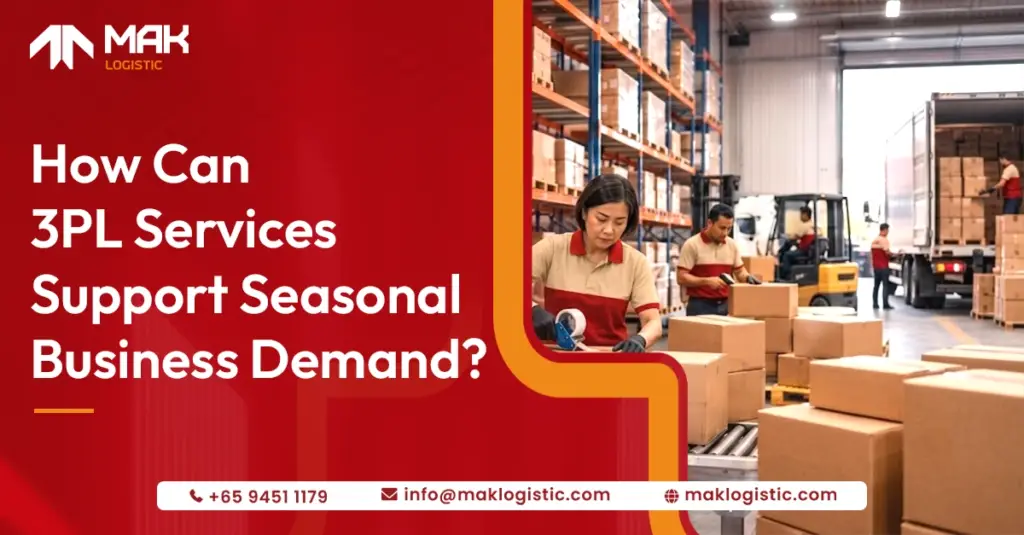
Seasonal demand can create significant opportunities for businesses, but it can also put pressure on warehousing, inventory management, order fulfillment, manpower, and transportation.
During peak periods, businesses may suddenly need more warehouse space, additional workers, faster order processing, and greater transportation capacity. Managing these requirements internally can become challenging when demand changes significantly from one season to another.
This is where 3PL services in Singapore can support businesses.
A third-party logistics provider can help businesses manage activities such as warehouse storage, inventory handling, order fulfillment, manpower, and transportation without requiring them to expand their own logistics infrastructure permanently.
For businesses with seasonal demand, 3PL support can provide the flexibility needed to scale logistics operations when demand increases and adjust capacity when demand returns to normal.
What Is Seasonal Business Demand?
Seasonal business demand refers to changes in customer demand during particular periods of the year.
The increase may be related to holidays, promotional campaigns, weather conditions, industry cycles, or major shopping events.
In Singapore, businesses may experience higher demand during periods such as:
- Chinese New Year
- Hari Raya
- Christmas
- Year-end shopping
- Major e-commerce campaigns
- Product launches
- Promotional periods
- Industry-specific peak seasons
For example, an e-commerce retailer may normally manage a consistent volume of orders but experience a significant increase during major online shopping campaigns.
The challenge is not simply selling more products. The business must also have sufficient inventory, warehouse capacity, manpower, packing resources, and transportation support to handle the additional demand.
Why Can Seasonal Demand Create Logistics Challenges?
When customer orders increase suddenly, several parts of the supply chain can come under pressure at the same time.
Limited Warehouse Space
Businesses may need to hold more inventory before a seasonal sales period.
If their existing warehouse is already operating close to capacity, there may not be enough space for additional stock.
Increased Order Volumes
More customer orders mean more picking, packing, checking, and dispatch activities.
A fulfillment process designed for normal demand may struggle to handle a sudden increase in orders.
Temporary Manpower Requirements
Businesses may need additional warehouse workers during peak periods.
Hiring permanent employees for a temporary increase in demand may not always be practical.
Transportation Pressure
Higher order volumes can also increase delivery requirements.
Businesses may need additional vehicles, drivers, delivery capacity, or better transportation coordination during peak periods.
Inventory Management Challenges
Higher inventory volumes can make stock tracking more complicated.
Businesses need to maintain accurate records so that products are available when required and orders can be fulfilled correctly.
How Can 3PL Services Support Seasonal Demand?
A 3PL provider can help businesses scale selected logistics activities according to their requirements.
Instead of investing in permanent warehouse infrastructure and resources for occasional peaks, businesses can outsource some logistics activities to a third-party provider.
A 3PL logistics service may support areas such as:
- Warehouse storage
- Inventory management
- Order fulfillment
- Picking and packing
- Warehouse manpower
- Transportation
- Dispatch coordination
- Returns handling
The exact services available depend on the provider and the business requirements.
Can 3PL Services Provide Flexible Warehouse Storage?
Yes. Flexible warehouse storage can be particularly useful when businesses need additional space for seasonal inventory.
For example, a retailer may receive additional stock several weeks before a major sales period.
Rather than expanding its permanent warehouse immediately, the business can use additional warehouse capacity through a logistics provider.
This can help businesses manage:
- Seasonal inventory
- Promotional stock
- Product launches
- Temporary stock overflow
- Imported products
- E-commerce campaign inventory
The goal is to have sufficient storage capacity when it is needed without creating unnecessary permanent capacity during slower periods.
How Can 3PL Providers Help With Seasonal Inventory Management?
Seasonal demand often requires businesses to bring in additional inventory before customer demand increases.
This makes inventory planning particularly important.
A 3PL provider can support inventory operations through activities such as:
Receiving Products
Products can be received and processed when they arrive at the warehouse.
Storage and Organisation
Inventory can be organised according to product type, SKU, demand, or fulfillment requirements.
Inventory Tracking
Accurate inventory records help businesses understand available stock and support order processing.
Picking Support
When orders increase, warehouse teams can pick products according to customer orders.
Stock Replenishment
Businesses can monitor inventory levels and plan replenishment according to demand.
Effective inventory management can help reduce the risk of stockouts, excess inventory, and fulfillment errors during peak periods.
How Can 3PL Services Help With Temporary Warehouse Manpower?
One of the biggest challenges during seasonal demand is having enough warehouse workers.
Permanent staffing levels may be sufficient during normal operations but inadequate during peak periods.
A 3PL provider that offers warehouse manpower services in Singapore can help businesses manage temporary increases in workload.
Additional manpower may support activities such as:
- Receiving
- Loading and unloading
- Picking
- Packing
- Sorting
- Labelling
- Inventory handling
- Dispatch preparation
This allows businesses to increase operational capacity without necessarily maintaining the same staffing level throughout the year.
How Can 3PL Providers Support E-commerce Fulfillment During Peak Seasons?
E-commerce businesses can experience large increases in orders during promotional campaigns and seasonal shopping periods.
During these periods, fulfillment teams need to process more orders within shorter timeframes.
A 3PL provider can support the fulfillment process by coordinating:
Inventory → Order Processing → Picking → Packing → Dispatch → Transportation
This creates a more structured workflow and can help businesses manage higher order volumes.
For businesses that do not operate their own fulfillment warehouse, outsourcing these activities can also reduce the need to invest heavily in warehouse infrastructure and additional operational resources.
How Can 3PL Services Support Seasonal Transportation Requirements?
Seasonal demand does not stop at the warehouse.
Once products are packed, they need to be transported to customers, retail locations, distribution points, or other destinations.
Higher order volumes can therefore increase transportation requirements.
3PL transportation support can help businesses coordinate:
- Delivery schedules
- Vehicle requirements
- Dispatch activities
- Warehouse-to-warehouse transportation
- Warehouse-to-customer deliveries
- Delivery documentation
- Peak-period transportation capacity
Better coordination between warehousing and transportation can help reduce unnecessary delays during busy periods.
What Are the Benefits of Using 3PL Services for Seasonal Demand?
1. Greater Flexibility
Businesses can adjust logistics capacity according to demand instead of maintaining the same resources throughout the year.
2. Scalable Warehouse Capacity
Additional storage can help businesses accommodate seasonal inventory without immediately expanding their permanent facilities.
3. Access to Additional Manpower
Temporary increases in warehouse workload can be supported with additional operational resources.
4. Better Fulfillment Capacity
3PL support can help businesses process higher order volumes during peak periods.
5. Transportation Support
Additional logistics coordination can help businesses manage increased delivery requirements.
6. Reduced Operational Pressure
Outsourcing selected logistics activities can allow internal teams to focus on sales, customer service, product development, and other core business activities.
7. Better Resource Planning
Businesses can align logistics resources with actual demand instead of maintaining excess capacity during slower periods.
When Should a Business Consider 3PL Support for Seasonal Demand?
Not every business needs to outsource its entire logistics operation.
However, 3PL support may be worth considering when:
- Order volumes increase significantly during certain periods
- Existing warehouse space becomes insufficient
- Temporary warehouse manpower is required
- Transportation requirements increase
- Inventory becomes difficult to manage internally
- Fulfillment teams struggle during peak periods
- The business wants to avoid permanent infrastructure expansion
- Seasonal demand is becoming more frequent or predictable
Businesses should assess their current logistics capacity and identify where the biggest bottlenecks occur.
How Should Businesses Prepare for Seasonal Demand With a 3PL Provider?
Planning ahead is important.
Businesses should not wait until orders start increasing before discussing additional logistics requirements.
Forecast Seasonal Demand
Review historical sales data and expected campaign performance to estimate inventory and order volumes.
Plan Inventory Early
Make sure sufficient stock can be received, stored, and managed before the peak period begins.
Confirm Warehouse Capacity
Determine whether additional storage space will be required.
Plan Manpower
Estimate how many additional workers may be required for receiving, picking, packing, and dispatch.
Coordinate Transportation
Discuss expected delivery volumes and transportation requirements with the logistics provider in advance.
Establish Clear Communication
Businesses and 3PL providers should agree on processes, responsibilities, reporting, escalation procedures, and peak-period requirements.
Early planning can help reduce last-minute operational pressure.
Can 3PL Services Help Businesses Scale After the Peak Season?
Yes.
One advantage of using a 3PL provider is that logistics requirements can be adjusted as demand changes.
During the peak season, a business may require:
More inventory + More warehouse space + More manpower + More fulfillment capacity + More transportation
After the peak period, these requirements may decrease.
A flexible 3PL arrangement can allow businesses to scale certain logistics resources down when demand returns to normal.
This can be particularly useful for businesses that experience significant seasonal fluctuations.
What Should Businesses Look for in a 3PL Provider?
Choosing the right provider is important because seasonal demand can put additional pressure on logistics operations.
Businesses should consider:
Warehouse Capacity
Does the provider have sufficient storage capacity to handle additional inventory?
Scalability
Can the provider increase operational support during peak periods?
Manpower Availability
Can additional warehouse workers be arranged when required?
Fulfillment Capabilities
Can the provider support receiving, picking, packing, and dispatch?
Transportation Coverage
Can transportation requirements be coordinated with warehouse operations?
Inventory Management
Does the provider have suitable processes for tracking and managing inventory?
Communication
Can the provider provide clear updates and respond quickly when operational requirements change?
Industry Experience
Experience with similar products, order volumes, or seasonal requirements can be valuable.
Singapore’s logistics sector is supported by a developed supply-chain ecosystem, and businesses can refer to the Singapore Economic Development Board’s logistics and supply chain management sector overview for broader information about the country’s logistics capabilities.
Businesses can also explore the Enterprise Singapore logistics industry resources for information related to Singapore’s logistics sector.
How Can MAK Logistic Support Seasonal Business Demand?
Seasonal demand requires businesses to have the right logistics capacity at the right time.
MAK Logistic provides 3PL services in Singapore, supporting businesses with warehouse storage, e-commerce fulfillment, warehouse manpower, transportation, and related logistics requirements.
Depending on the business’s needs, support can include:
- Warehouse storage
- Inventory handling
- Picking and packing
- E-commerce fulfillment
- Warehouse manpower
- Transportation services
- Dispatch coordination
- 3PL logistics support
For businesses experiencing seasonal increases in inventory or order volumes, having an experienced logistics partner can provide additional operational flexibility.
Instead of building permanent capacity for occasional demand peaks, businesses can explore logistics solutions that are better aligned with their actual requirements.
Is 3PL a Good Solution for Seasonal Businesses?
For many businesses, 3PL services can be a practical way to manage seasonal fluctuations.
The main advantage is flexibility.
A business may need additional warehouse space, manpower, fulfillment capacity, and transportation during peak periods but significantly fewer resources during normal periods.
A suitable 3PL arrangement can help businesses access additional logistics capacity when required while reducing the pressure of managing every activity internally.
However, businesses should evaluate their order volumes, inventory requirements, storage duration, operational needs, and expected growth before choosing a 3PL solution.
“Seasonal demand should create opportunities for growth, not become a logistics bottleneck.”
Frequently Asked Questions
What are 3PL services?
3PL services are logistics activities outsourced to a third-party logistics provider. Depending on the provider, services can include warehousing, inventory management, order fulfillment, transportation, manpower, and other logistics operations.
How can 3PL help during seasonal demand?
A 3PL provider can help businesses scale warehouse storage, manpower, fulfillment, inventory handling, and transportation capacity during periods of increased demand.
Can 3PL providers provide temporary warehouse storage?
Yes. Depending on the provider, businesses may be able to use flexible or temporary warehouse storage to accommodate seasonal inventory and temporary stock increases.
Is 3PL suitable for e-commerce businesses during peak seasons?
Yes. E-commerce businesses can use 3PL support to manage increased inventory, order volumes, picking and packing, fulfillment, and transportation during seasonal or promotional periods.
When should businesses start planning for seasonal demand?
Businesses should ideally begin planning before the peak period. Early forecasting allows them to arrange inventory, warehouse space, manpower, fulfillment capacity, and transportation in advance.
Conclusion
Seasonal demand can help businesses increase sales, but it can also put significant pressure on logistics operations.
Without sufficient warehouse space, manpower, fulfillment capacity, inventory management, and transportation support, businesses may struggle to process increased orders efficiently.
3PL services in Singapore can provide a flexible way to manage these challenges.
By outsourcing selected logistics activities, businesses can scale storage, manpower, fulfillment, and transportation according to demand.
The key is to plan early, understand seasonal requirements, and work with a logistics partner that can support your business before, during, and after the peak period.
With the right 3PL strategy, businesses can focus on taking advantage of seasonal opportunities while keeping their logistics operations organised and scalable.