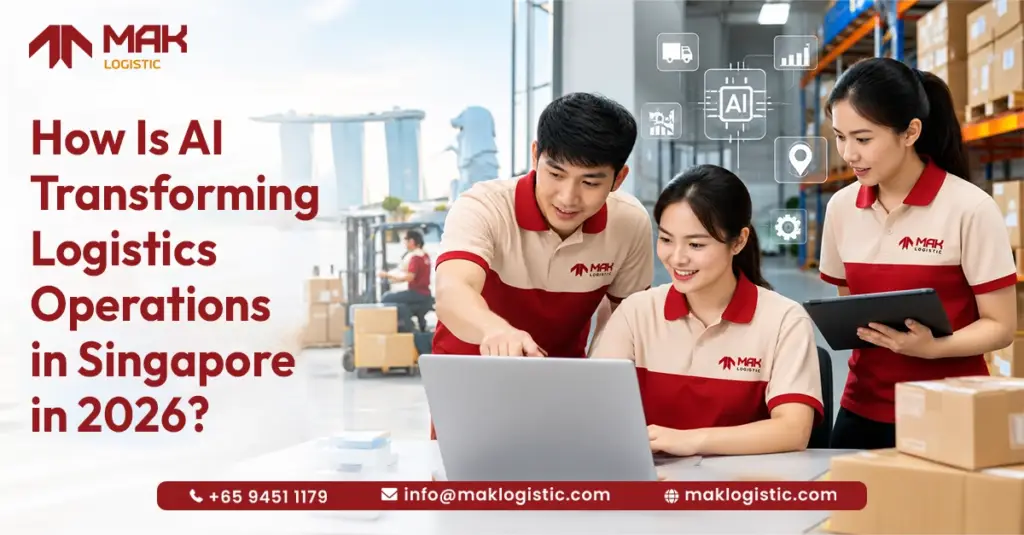
The future of logistics is not simply about moving products faster. It is about using better data and smarter technology to make better operational decisions.
Artificial intelligence is becoming an increasingly important part of logistics and supply chain operations.
In 2026, logistics businesses are looking beyond basic digitalisation and exploring how AI can support forecasting, route planning, warehouse operations, inventory management, customer service, and decision-making.
For Singapore, this shift is particularly relevant because logistics plays an important role in the country’s position as a regional and global supply chain hub.
Singapore’s 2026 Budget identified connectivity and logistics as one of the areas where national AI Missions can support transformation, including moving goods more efficiently and strengthening airport and seaport operations.
So, how is AI in logistics changing the way businesses operate in Singapore in 2026?
What Is AI in Logistics?
AI in logistics refers to the use of artificial intelligence technologies to analyse data, identify patterns, make predictions, automate certain decisions, and support logistics operations.
Depending on the application, AI can work with information such as:
- Order volumes
- Inventory levels
- Delivery locations
- Traffic information
- Warehouse activity
- Vehicle availability
- Customer demand
- Historical shipment data
- Operational performance
Instead of relying entirely on manual planning, businesses can use AI-supported systems to identify patterns and provide recommendations or automate selected processes.
AI does not necessarily replace existing logistics systems. In many cases, it works alongside warehouse management systems, transportation management systems, inventory platforms, sensors, and other digital tools.
Why Is AI Becoming Important for Singapore’s Logistics Sector?
Logistics operations involve large amounts of information and many interconnected activities.
A single order may involve:
Supplier → Warehouse → Inventory → Picking → Packing → Transportation → Customer
Each stage creates data that can potentially be analysed and used to improve planning.
Singapore’s logistics sector already has programmes focused on technology adoption, analytics, automation, supply chain visibility, and digitalisation. Enterprise Singapore highlights data-driven supply chain visibility and automation as opportunities for logistics businesses, while its logistics resources include the Logistics Industry Digital Plan for SMEs.
At the same time, Singapore’s broader AI strategy is being strengthened in 2026, with the National AI Council established in February and refreshed priorities announced in May.
This creates a broader environment for logistics companies to explore practical AI applications.
How Is AI Transforming Warehouse Operations?
Warehouses generate large amounts of operational data.
AI can help analyse this information and support decisions related to inventory, picking, storage, and workforce planning.
1. Smarter Inventory Forecasting
AI can analyse historical sales and inventory data to identify demand patterns.
For example, a system may identify that certain products consistently experience higher demand during particular periods.
Businesses can use these insights to plan:
- Inventory replenishment
- Warehouse capacity
- Purchasing
- Stock allocation
- Manpower requirements
Better forecasting can help businesses avoid unnecessary overstocking while reducing the risk of inventory shortages.
2. More Efficient Warehouse Layouts
AI and analytics can help businesses analyse product movement within a warehouse.
If certain products are picked frequently, businesses may consider positioning them in locations that reduce unnecessary travel.
This can support:
- Shorter picking routes
- Reduced walking time
- Better space utilisation
- Faster order processing
The actual benefit depends on warehouse design, product characteristics, order volumes, and the quality of available data.
3. Smarter Picking Operations
AI can support picking decisions by analysing order patterns and product locations.
For example, an AI-enabled system could help determine efficient picking sequences for multiple orders.
This can be particularly useful for e-commerce warehouses where order volumes can change quickly.
4. Warehouse Automation
AI can also work alongside robotics and automated systems.
Enterprise Singapore identifies automation as an opportunity for logistics businesses, including the use of robots that can adjust resources according to operational requirements.
AI can potentially help coordinate automated equipment, identify patterns in warehouse activity, and support more dynamic workflows.
Can AI Improve Inventory Management?
Yes.
Inventory management is one of the areas where data-driven systems can provide useful operational support.
AI can analyse:
- Historical demand
- Current stock levels
- Order frequency
- Product movement
- Seasonal patterns
- Replenishment requirements
This can help businesses make more informed inventory decisions.
For example, if a product is consistently selling faster than expected, an AI-supported system may identify the trend earlier than a manual review.
However, AI recommendations are only as useful as the underlying data. Incorrect inventory records or incomplete information can lead to inaccurate outputs.
How Can AI Improve Transportation Planning?
Transportation involves multiple variables.
Businesses need to consider:
- Delivery locations
- Vehicle availability
- Delivery schedules
- Traffic conditions
- Order priorities
- Driver availability
- Warehouse operating hours
AI can analyse these factors to support route planning and scheduling.
Singapore’s government has specifically identified AI applications in connectivity and logistics, including improving the movement of goods. A 2026 maritime-sector speech also highlighted AI applications for forecasting, routing optimisation, and coordination of flows across complex networks.
AI-Powered Route Optimisation
Instead of planning every route manually, AI-supported systems can analyse available information and suggest more efficient routes.
This may help businesses:
- Reduce unnecessary travel
- Improve vehicle utilisation
- Coordinate multiple deliveries
- Adjust routes when conditions change
- Improve delivery planning
Route optimisation does not guarantee shorter delivery times in every situation because traffic, road restrictions, customer availability, and operational constraints can change.
How Can AI Improve Supply Chain Visibility?
Supply chains involve multiple parties.
A business may work with:
- Suppliers
- Warehouses
- Transport providers
- Distributors
- Fulfillment providers
- Customers
When information is stored in separate systems, it can be difficult to obtain a complete view of an order or shipment.
AI can analyse information from connected systems and help identify:
- Delays
- Inventory shortages
- Bottlenecks
- Unusual patterns
- Capacity issues
- Potential disruptions
Singapore’s logistics sector is already focused on improving supply chain visibility through data infrastructure such as SGTraDex, which is intended to connect ecosystem partners and reduce reliance on manual, paper-based processes.
AI can build on this broader digital foundation by helping businesses interpret large amounts of operational data.
Can AI Help With Demand Forecasting?
Demand forecasting is one of the most practical AI applications for logistics.
Traditional forecasting may rely heavily on historical sales data and manual analysis.
AI can potentially consider a wider range of information and identify patterns across large datasets.
For example, businesses may use AI-supported forecasting to estimate:
- Expected order volumes
- Product demand
- Seasonal changes
- Inventory requirements
- Warehouse capacity
- Transportation requirements
For an e-commerce business, better demand forecasting can help prepare warehouse and fulfillment operations before order volumes increase.
How Can AI Support E-commerce Fulfillment?
E-commerce fulfillment involves many repetitive and time-sensitive processes.
AI can support activities such as:
Order → Inventory Check → Picking → Packing → Dispatch → Delivery
Potential applications include:
- Predicting order volumes
- Prioritising orders
- Optimising picking sequences
- Identifying inventory requirements
- Supporting warehouse scheduling
- Predicting delivery requirements
For businesses using an e-commerce fulfillment service in Singapore, AI-enabled tools can potentially help connect order information with warehouse and transportation planning.
The objective is not simply automation. The larger goal is to use data to make fulfillment operations more responsive.
How Can AI Help Manage Logistics Manpower?
AI and automation can change how warehouse and transportation teams work.
For example, AI can help businesses forecast workforce requirements based on expected order volumes.
Instead of maintaining the same workforce level every day, businesses may be able to plan staffing around:
- Expected order volumes
- Receiving schedules
- Picking requirements
- Packing workload
- Dispatch schedules
- Seasonal demand
This can support better workforce planning.
However, AI does not remove the need for people from logistics operations.
Singapore’s Ministry of Manpower reported in April 2026 that AI adoption among firms remained at an early stage overall, and there was no indication of significant job displacement at that point.
This suggests that, at least in the current stage of adoption, businesses are still navigating how AI and human workers should work together.
Does AI Replace Warehouse Workers?
Not necessarily.
AI, automation, and robotics can reduce certain repetitive tasks, but logistics still requires people for activities such as:
- Warehouse supervision
- Exception handling
- Product handling
- Quality checks
- Equipment management
- Customer coordination
- Operational decision-making
The impact depends on the technology being implemented and the type of logistics operation.
A more practical way to look at AI is as a tool that can support employees by reducing repetitive work and providing better information for decision-making.
Singapore’s government has also emphasised worker retraining and support as technology changes the nature of work.
What Are the Benefits of AI in Logistics?
When implemented appropriately, AI can support several areas of logistics operations.
Better Forecasting
Businesses can use data patterns to support inventory and demand planning.
Improved Route Planning
AI can help analyse delivery information and identify routing options.
Greater Operational Visibility
Businesses can gain better insight into inventory, orders, transportation, and potential bottlenecks.
Reduced Manual Work
Certain repetitive planning and administrative tasks can be automated.
Better Resource Planning
Businesses can plan warehouse space, manpower, and transportation capacity according to expected demand.
Faster Decision-Making
AI can analyse large amounts of information faster than manual processes.
However, these benefits depend on data quality, system integration, implementation, and how employees use the technology.
What Are the Challenges of Using AI in Logistics?
AI is not a solution that businesses can implement without preparation.
Data Quality
AI systems require reliable data.
Incorrect inventory records, missing information, or inconsistent data can affect results.
System Integration
AI tools may need to connect with existing warehouse, inventory, order, and transportation systems.
Implementation Costs
Businesses need to consider software, hardware, integration, training, and ongoing maintenance costs.
Workforce Skills
Employees may need training to use new AI-enabled tools effectively.
Data Security
Logistics systems contain operational and business information that needs appropriate protection.
Human Oversight
AI recommendations should be reviewed appropriately, particularly when decisions can affect customers, safety, costs, or business continuity.
How Should Singapore Businesses Start Using AI in Logistics?
Businesses do not necessarily need to transform their entire logistics operation at once.
A practical approach is to start with a specific operational problem.
Step 1: Identify a Bottleneck
Look for areas where the business spends significant time or resources.
For example:
- Route planning
- Inventory forecasting
- Manual reporting
- Order processing
- Warehouse scheduling
Step 2: Check Data Availability
Determine whether the business has enough accurate historical and operational data.
Step 3: Start With a Defined Use Case
Instead of implementing AI across every department, select one process where measurable improvement can be evaluated.
Step 4: Train Employees
Workers should understand how the system works and how to respond to AI-generated recommendations.
Step 5: Measure Results
Track relevant metrics before and after implementation.
These may include:
- Processing time
- Order accuracy
- Inventory accuracy
- Delivery performance
- Labour hours
- Vehicle utilisation
- Operating costs
Step 6: Expand Gradually
If the initial implementation produces useful results, businesses can consider applying similar technology to other logistics processes.
Enterprise Singapore’s logistics programmes include support for technology adoption, analytics, automation, and workforce capability development, while its Centre of Innovation for Supply Chain Management focuses on analytics, automation simulations, and supply chain applications.
What Does the Future of AI in Singapore Logistics Look Like?
AI adoption in logistics is likely to become increasingly connected with other technologies rather than operating independently.
Future logistics systems may combine:
AI + Automation + IoT + Data Analytics + Robotics + Digital Platforms
For example, warehouse sensors can generate operational data, AI can analyse the information, and automated systems can respond to selected conditions.
Singapore is already pursuing broader AI transformation. Enterprise Singapore’s 2026 Champions of AI programme is designed to support leading Singapore-based companies in transforming operations and workforce capabilities through enterprise-wide AI adoption.
In transport, Singapore has also announced plans to progressively scale autonomous vehicles to address manpower constraints and growing transport needs.
This indicates that AI and automation are becoming part of a broader transformation of Singapore’s transport and logistics ecosystem.
How Can MAK Logistic Support Businesses as Logistics Technology Evolves?
Technology is changing how businesses manage logistics, but the fundamentals remain important.
Businesses still need:
- Warehouse storage
- Inventory handling
- E-commerce fulfillment
- Transportation
- Warehouse manpower
- Order processing
- 3PL support
MAK Logistic provides logistics services in Singapore covering warehouse storage, e-commerce fulfillment, transportation, warehouse manpower, and 3PL services.
For businesses exploring more data-driven logistics operations, having organised warehouse and fulfillment processes provides an important foundation.
AI can support decision-making, but accurate inventory information, clear workflows, trained employees, and reliable operational processes remain essential.
Frequently Asked Questions
How is AI being used in logistics in Singapore?
AI is being explored and applied across areas such as demand forecasting, route optimisation, supply chain visibility, warehouse operations, automation, and resource planning. Singapore’s government has identified AI and digitalisation as important areas for the future of logistics and connectivity.
Can AI reduce logistics costs?
AI can potentially help reduce costs by improving route planning, inventory forecasting, workforce planning, and operational efficiency. The actual savings depend on the use case, data quality, implementation, and business processes.
Will AI replace warehouse workers in Singapore?
AI and automation may change some warehouse tasks, but they do not automatically eliminate the need for workers. Human employees continue to be important for supervision, physical handling, exception management, quality control, and operational decision-making. Singapore’s 2026 workforce data indicates that significant job displacement from AI had not been observed at the time of the report.
Can small logistics businesses use AI?
Yes. Small businesses can start with focused AI or digital solutions for areas such as inventory management, forecasting, reporting, customer communication, or route planning. Singapore’s Logistics Industry Digital Plan provides SMEs with a step-by-step approach to adopting digital solutions.
What is the role of AI in e-commerce fulfillment?
AI can support e-commerce fulfillment through demand forecasting, inventory planning, order prioritisation, picking optimisation, warehouse scheduling, and transportation planning. These applications can help fulfillment operations respond to changing order volumes.
Conclusion
AI is becoming an important part of the transformation of logistics operations in Singapore.
In 2026, its applications extend across demand forecasting, inventory management, warehouse operations, route optimisation, supply chain visibility, fulfillment, and workforce planning.
However, successful AI adoption is not simply about installing new technology.
Businesses need accurate data, connected systems, clear processes, trained employees, and appropriate human oversight.
For Singapore’s logistics sector, AI is increasingly being positioned alongside automation, digital platforms, analytics, and other technologies to improve efficiency and resilience.
For businesses, the practical starting point is to identify a specific logistics challenge and determine whether AI can provide a measurable improvement.