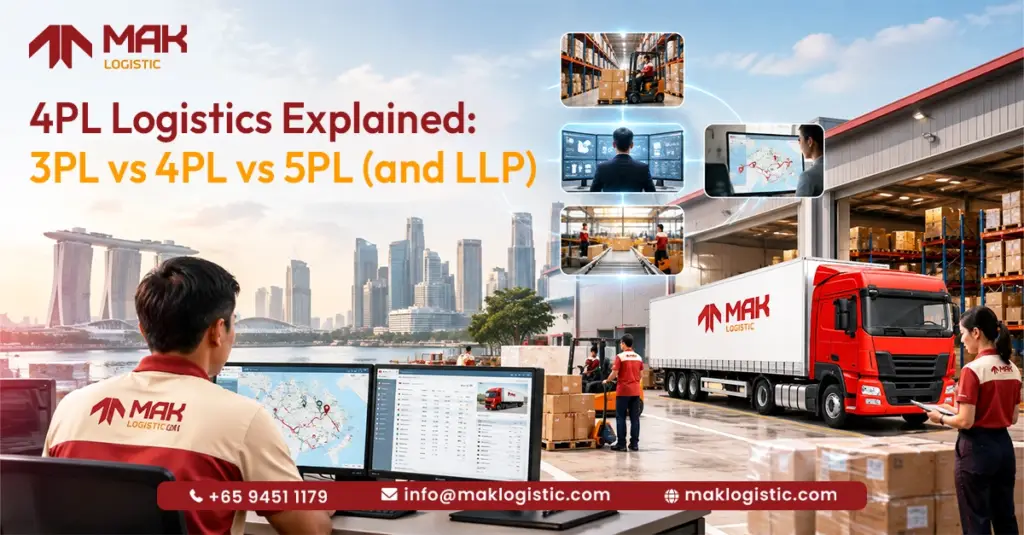
As supply chains become more complex, businesses increasingly work with external logistics partners to manage warehousing, transportation, fulfillment, technology, and supply chain coordination.
You may already be familiar with 3PL (Third-Party Logistics). But as logistics requirements become more integrated, businesses may also come across terms such as 4PL, 5PL, and LLP (Lead Logistics Provider).
Although these terms are sometimes used interchangeably, they describe different levels of logistics involvement and supply chain management.
Understanding the difference between these models can help businesses determine which logistics approach is appropriate for their operations.
What Is 3PL Logistics?
3PL stands for Third-Party Logistics.
A 3PL provider typically manages specific logistics activities on behalf of a business. These can include warehousing, transportation, inventory handling, order fulfillment, picking and packing, and distribution.
For example, a business may outsource:
- Warehouse storage
- Inventory management
- Transportation
- Picking and packing
- E-commerce fulfillment
- Returns management
- Warehouse manpower
The business generally continues to manage its broader supply chain strategy, while the 3PL provider handles the outsourced logistics activities.
When Is 3PL Suitable?0
3PL services in Singapore can be useful for businesses that want to outsource operational logistics without handing over complete supply chain management.
For example, an e-commerce business may use a 3PL provider for warehouse storage, order fulfillment, and transportation while continuing to manage suppliers, sales channels, and overall business strategy internally.
What Is 4PL Logistics?
4PL stands for Fourth-Party Logistics.
A 4PL provider generally operates at a broader strategic and coordination level than a traditional 3PL.
Instead of focusing mainly on individual logistics activities, a 4PL provider can coordinate multiple logistics providers, systems, processes, and supply chain functions on behalf of a business.
A 4PL model may involve:
- Supply chain planning
- Coordination of multiple logistics providers
- Transportation management
- Warehouse coordination
- Technology integration
- Performance monitoring
- Data and reporting
- Supply chain optimisation
The 4PL provider can act as a central point of coordination across different logistics activities.
How Does 4PL Differ From 3PL?
The simplest way to understand the distinction is:
3PL = Performs logistics activities
4PL = Coordinates and manages multiple logistics activities and providers
For example, a business may use one 3PL provider for warehousing and another transportation company for distribution. A 4PL arrangement could coordinate these providers as part of a broader supply chain strategy.
The exact scope of 4PL logistics can vary depending on the contract and service model.
What Is 5PL Logistics?
5PL stands for Fifth-Party Logistics.
5PL is generally associated with highly integrated supply chain management that uses technology, automation, data, and network-level coordination.
A 5PL model can focus on managing logistics networks and using technology to optimise multiple supply chain activities.
This may involve:
- Advanced supply chain technology
- Automation
- Data analysis
- Network optimisation
- Digital logistics platforms
- Integration of multiple logistics providers
- E-commerce logistics management
The concept is particularly relevant to highly digital and complex supply chains where technology plays a significant role in coordinating logistics activities.
Terminology and service definitions can vary across logistics providers and markets, so businesses should always examine the actual scope of the service.
What Is an LLP in Logistics?
LLP stands for Lead Logistics Provider.
An LLP is generally a logistics partner that takes a lead role in coordinating multiple logistics activities and providers across a supply chain.
The term is often used in discussions about supply chain orchestration.
An LLP may coordinate:
- Multiple 3PL providers
- Transportation providers
- Warehousing operations
- Freight and distribution activities
- Technology systems
- Performance management
- Supply chain reporting
In practice, the responsibilities of an LLP can overlap with those commonly associated with 4PL models.
The exact meaning depends on how the logistics relationship is structured.
3PL vs 4PL vs 5PL vs LLP: What Is the Difference?
The key differences can be understood through the level of involvement.
| Logistics Model | Main Role | Typical Focus |
| 3PL | Executes logistics activities | Warehousing, transportation, fulfillment |
| 4PL | Coordinates logistics activities and providers | Supply chain management and integration |
| 5PL | Uses technology and network-level coordination | Digital and automated supply chain management |
| LLP | Leads and coordinates logistics partners | End-to-end supply chain orchestration |
These categories are useful for understanding logistics models, but real-world service arrangements can overlap.
A provider may offer services that cover more than one category depending on its capabilities and contractual responsibilities.
What Is the Difference Between 3PL and 4PL?
The main difference in 3PL vs 4PL is the scope of responsibility.
A 3PL generally performs specific logistics functions, such as storing products, transporting goods, or fulfilling orders.
A 4PL typically takes a broader role in coordinating multiple logistics activities and providers.
For example:
3PL model:
Business → 3PL → Warehouse & Transportation
4PL model:
Business → 4PL → Multiple Logistics Providers → Warehouse, Transportation, Technology & Other Services
A business choosing between these models should consider how much logistics coordination it wants to manage internally.
Is 4PL Better Than 3PL?
There is no universal answer because the appropriate model depends on the business.
A company with straightforward warehousing and transportation requirements may only need 3PL services.
A large organisation managing multiple logistics providers, locations, systems, and transportation networks may require a more coordinated model.
The important consideration is the complexity of the supply chain and the level of management required, rather than simply choosing a higher-numbered logistics model.
When Should a Business Consider 4PL Logistics?
A business may consider 4PL logistics in Singapore when its logistics network becomes too complex to coordinate efficiently internally.
Potential situations include:
- Multiple logistics providers
- Multiple warehouses
- Multiple transportation partners
- Complex international supply chains
- Large-scale distribution networks
- Multiple technology platforms
- Need for centralised logistics reporting
- Need for broader supply chain coordination
For smaller businesses with straightforward logistics requirements, a 3PL arrangement may be sufficient.
How Do 3PL Services Support Singapore Businesses?
For many businesses in Singapore, third-party logistics in Singapore is a practical way to outsource operational logistics.
A 3PL provider can support services such as:
- Warehouse storage in Singapore
- Transportation services
- E-commerce fulfillment
- Inventory management
- Picking and packing
- Warehouse manpower
- Order fulfillment
- Distribution
- Returns handling
This can allow businesses to access logistics infrastructure and operational support without managing every activity internally.
For e-commerce companies, manufacturers, wholesalers, distributors, and retailers, the right 3PL setup can be adapted to different operational requirements.
How Does Technology Affect 4PL and 5PL Logistics?
Technology is an important part of modern supply chain coordination.
Businesses can use logistics technology to improve visibility across inventory, transportation, warehouse operations, and order fulfillment.
Depending on the logistics model, technology may support:
- Real-time inventory visibility
- Transportation tracking
- Warehouse management
- Order management
- Data analysis
- Performance reporting
- Automated workflows
- Provider coordination
In more advanced supply chain models, technology can help bring information from different logistics partners into a more connected operating environment.
Can a 3PL Provider Become Part of a 4PL Network?
Yes.
A 3PL provider can operate as one of the logistics partners coordinated by a 4PL or LLP.
For example, a business may have:
- One provider managing warehouse operations
- Another provider managing transportation
- A technology provider managing logistics software
- A 4PL or LLP coordinating the overall network
In this structure, the 3PL continues to perform its operational responsibilities while the higher-level logistics partner manages coordination.
Which Logistics Model Is Right for Your Business?
The appropriate model depends on the complexity of your supply chain.
Choose 3PL when:
- You want to outsource warehouse operations
- You need transportation support
- You require e-commerce fulfillment
- You need additional warehouse manpower
- You want operational logistics support without outsourcing overall supply chain management
Consider 4PL or LLP when:
- You manage several logistics providers
- Your supply chain has multiple locations
- You need centralised coordination
- You require broader supply chain visibility
- Logistics management has become difficult to coordinate internally
Consider 5PL concepts when:
- Your operations are highly digital
- Technology is central to your logistics strategy
- You manage large logistics networks
- Automation and data-driven optimisation are important to your operation
The terminology can vary between providers, so businesses should examine the actual services, responsibilities, technology, and contractual scope rather than relying only on the 3PL, 4PL, or 5PL label.
How Can MAK Logistic Support Businesses in Singapore?
MAK Logistic provides logistics solutions in Singapore, including 3PL services, warehouse storage, transportation, e-commerce fulfillment, and warehouse manpower supply.
Its 3PL solutions can support businesses with operational requirements such as:
- Warehouse storage
- Inventory handling
- Picking and packing
- Order fulfillment
- Transportation
- E-commerce fulfillment
- Warehouse manpower
For businesses that need operational logistics support without building and managing every function internally, a 3PL model can provide a practical solution.
As logistics requirements grow, businesses can also evaluate whether they need broader coordination across multiple providers and supply chain functions.
Frequently Asked Questions
1. What is the difference between 3PL and 4PL?
A 3PL provider typically performs specific logistics activities such as warehousing, transportation, and fulfillment. A 4PL generally takes a broader role in coordinating multiple logistics providers and supply chain activities.
2. What does 5PL mean in logistics?
5PL refers to a logistics model associated with technology-driven and network-level supply chain coordination. It can involve automation, data, digital platforms, and optimisation across multiple logistics activities.
3. What is an LLP in logistics?
An LLP, or Lead Logistics Provider, takes a leading coordination role across multiple logistics providers and supply chain activities. Its scope can overlap with 4PL models depending on the service arrangement.
4. Is 4PL more suitable than 3PL for every business?
No. The appropriate model depends on the complexity of the business’s supply chain. Businesses with straightforward logistics requirements may only need 3PL services, while complex multi-provider networks may require broader coordination.
5. Can a 3PL provider support e-commerce businesses in Singapore?
Yes. A 3PL provider can support e-commerce businesses through warehouse storage, inventory management, picking and packing, order fulfillment, transportation, returns handling, and other logistics services.
Conclusion
3PL, 4PL, 5PL, and LLP represent different approaches to managing logistics and supply chain activities.
3PL focuses mainly on executing logistics operations. 4PL and LLP models generally involve broader coordination, while 5PL is associated with technology-driven network-level logistics management.
The right model depends on the size, complexity, technology requirements, and logistics structure of each business.
For many businesses in Singapore, starting with practical 3PL services such as warehouse storage, transportation, e-commerce fulfillment, inventory handling, and manpower support can provide a flexible way to manage day-to-day logistics operations.
Looking for 3PL services in Singapore?
MAK Logistic provides warehouse storage, transportation, e-commerce fulfillment, manpower supply, and 3PL logistics support.
📞 +65 9451 1179
📧 info@maklogistic.com
🌐 maklogistic.com
#3PL #4PL #5PL #LLP #4PLLogistics #3PLSingapore #4PLSingapore #LogisticsSingapore #SupplyChainManagement #WarehouseStorageSingapore #EcommerceFulfillment #MAKLogistic