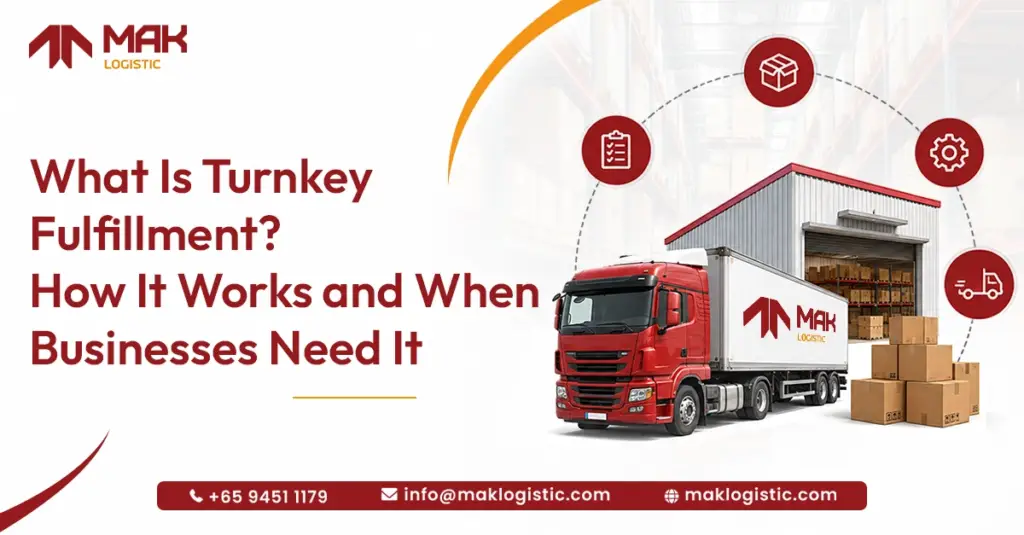
Managing products from the moment they arrive at a warehouse until they reach the customer involves multiple activities. Inventory needs to be received and stored, orders need to be processed, products need to be picked and packed, and deliveries need to be coordinated.
“As order volumes grow, businesses need more than storage. They need a coordinated fulfillment process that connects inventory, warehousing, order processing, and transportation.”
For businesses handling these activities internally, managing each logistics function separately can become increasingly complex as order volumes grow.
This is where turnkey fulfillment can help.
A turnkey fulfillment solution brings multiple logistics activities together under one service arrangement. Instead of coordinating separate providers for warehousing, inventory management, order fulfillment, and transportation, businesses can work with one logistics partner to manage the process.
For businesses in Singapore, this approach can provide a more organised way to manage growing logistics requirements.
What Is Turnkey Fulfillment?
Turnkey fulfillment is a complete logistics solution where a provider manages multiple stages of the fulfillment process on behalf of a business.
Depending on the provider and business requirements, this can include:
- Receiving products
- Inventory storage
- Inventory management
- Order processing
- Picking and packing
- Labelling
- Dispatch preparation
- Transportation coordination
- Delivery
The idea is simple: the business provides its products and order requirements, while the fulfillment provider manages the operational activities needed to move those products through the supply chain.
This makes turnkey fulfillment different from using a service provider for only one activity, such as warehouse storage.
How Does Turnkey Fulfillment Work?
A typical turnkey fulfillment process can follow these stages:
Products Received → Inventory Stored → Customer Order Received → Products Picked → Orders Packed → Dispatch Prepared → Transportation Arranged → Delivery Completed
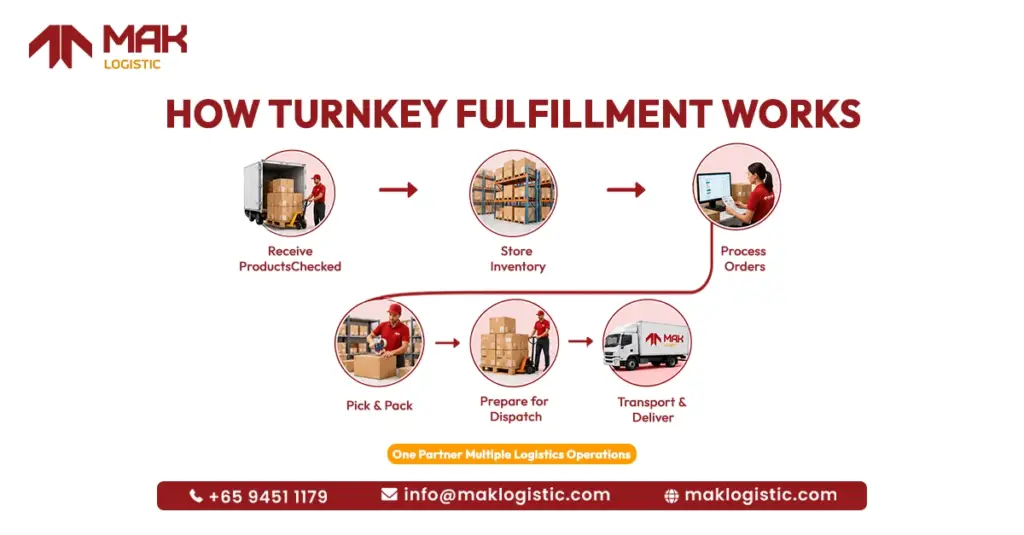
1. Receiving Products
The fulfillment provider receives products from the business or its suppliers.
Products can then be checked, recorded, and prepared for storage according to the agreed warehouse procedures.
2. Inventory Storage
Products are stored in the warehouse until they are required for customer orders or distribution.
Depending on the business requirements, storage may include pallet storage, racked storage, or other suitable warehouse arrangements.
3. Order Processing
When a customer places an order, the order information is processed for fulfillment.
Accurate order information is important because it helps the warehouse team identify the correct products and quantities. For businesses requiring order fulfillment service in Singapore solutions, having an organised process can help manage customer orders more efficiently.
4. Picking and Packing
Warehouse personnel pick the required products from storage and prepare them for packing.
Orders are then packed according to the business’s product and packaging requirements.
5. Dispatch Preparation
Once an order is packed, it is prepared for collection or transportation.
This stage connects warehouse operations with transportation planning.
6. Transportation and Delivery
The completed order is handed over for transportation and delivered to the required destination.
By connecting these activities, turnkey fulfillment can create an end to end fulfillment in Singapore process rather than requiring the business to manage each logistics activity separately.
What Services Are Included in Turnkey Fulfillment?
Turnkey fulfillment does not have one fixed service package. The exact services depend on the provider and the business’s requirements.
Common services can include:
Warehouse Storage
Products are stored securely until they are required for customer orders or distribution.
Businesses looking for warehouse fulfillment Singapore solutions can use outsourced warehouse operations to manage product storage and order preparation without operating their own fulfillment facility.
Inventory Management
Inventory records can be maintained to help businesses monitor product availability and movement.
Order Fulfillment
The provider manages the operational steps required to process customer orders, including picking, packing, and dispatch.
Pick and Pack
Products are picked from storage, checked, packed, and prepared for dispatch.
Dispatch Coordination
Completed orders are organised for collection and transportation.
Transportation
Transportation can be coordinated according to delivery locations, schedules, and product requirements.
Delivery
The logistics provider can arrange the movement of products from the warehouse to the required destination.
For businesses looking for turnkey fulfillment services Singapore, combining these activities through one provider can simplify logistics management.
How Is Turnkey Fulfillment Different From Traditional Fulfillment?
Traditional fulfillment may focus mainly on processing customer orders, including picking, packing, and dispatch.
Turnkey fulfillment can cover a broader range of logistics activities.
| Traditional Fulfillment | Turnkey Fulfillment |
| Mainly order processing | Broader end-to-end logistics support |
| Picking and packing | Storage, inventory, fulfillment and transportation |
| May require separate logistics partners | Multiple services can be managed through one provider |
| Limited operational scope | Wider logistics coordination |
| Suitable for specific fulfillment needs | Suitable for businesses seeking a more complete solution |
The exact scope depends on the provider. Businesses should therefore confirm which services are included before selecting a turnkey fulfillment partner.
What Are the Benefits of Turnkey Fulfillment?
One Coordinated Logistics Process
Instead of managing separate providers for storage, fulfillment, and transportation, businesses can coordinate multiple activities through one logistics partner.
This can create a more connected warehousing and fulfillment Singapore process, particularly for businesses managing regular inventory movement and customer orders.
Reduced Operational Complexity
Managing several logistics functions internally requires people, systems, warehouse space, and transportation arrangements.
Outsourcing these activities can reduce the number of operational tasks handled directly by the business.
Better Coordination Between Warehousing and Transportation
Warehouse and transportation activities are closely connected.
If an order is not ready when a vehicle arrives, the delivery schedule can be affected. Coordinating these activities through one fulfillment process can help reduce unnecessary delays.
Flexible Storage and Fulfillment
Businesses may have changing inventory and order requirements. A fulfillment provider can offer storage and operational support according to the agreed requirements.
More Time to Focus on Core Business Activities
When logistics operations are outsourced, business teams can spend more time on sales, marketing, product development, and customer relationships.
Support for Growing Order Volumes
As order volumes increase, manually managing fulfillment can become more difficult. A turnkey model can provide a structured process for handling increasing logistics requirements.
When Does a Business Need Turnkey Fulfillment?
Not every business needs a complete fulfillment solution from the beginning.
Turnkey fulfillment can become particularly useful when a business starts experiencing operational complexity.
When Order Volumes Are Increasing
Processing a small number of orders may be manageable internally. As order volumes increase, businesses may need additional warehouse space, manpower, packing resources, and transportation coordination.
When Warehouse Operations Become Difficult to Manage
Businesses that do not want to operate their own warehouse can outsource storage and fulfillment activities to a logistics provider.
When Multiple Logistics Providers Are Involved
Using separate companies for storage, fulfillment, and transportation can require additional coordination.
A turnkey solution can bring these activities together.
When Expanding Into E-Commerce
E-commerce businesses need to manage inventory, customer orders, picking, packing, and delivery regularly.
E-commerce fulfillment Singapore solutions can help online businesses manage these operational requirements without building their own fulfillment infrastructure.
When Businesses Want to Improve Logistics Coordination
If warehouse and transportation activities are managed separately, communication gaps can create delays.
A coordinated fulfillment process can help connect these activities.
Is Turnkey Fulfillment Suitable for E-Commerce Businesses?
Yes. E-commerce businesses can benefit significantly from turnkey fulfillment because online orders involve several connected logistics activities.
A typical e-commerce process may look like:
Inventory Storage → Online Order → Order Processing → Picking → Packing → Dispatch → Delivery
As order volumes grow, managing each step internally can require significant time and resources.
A turnkey fulfillment provider can manage the operational side while the e-commerce business focuses on its online store, products, marketing, and customers.
This can be particularly useful for businesses selling products across Singapore or using Singapore as a distribution point for regional markets.
For businesses comparing fulfillment services Singapore, it is important to consider whether the provider can support storage, order processing, packing, transportation, and delivery as part of one coordinated operation.
Singapore’s established logistics infrastructure and connectivity support businesses operating regional supply chains. The Singapore Economic Development Board highlights the country’s role as a major logistics and supply chain hub with strong connectivity and infrastructure. Singapore Economic Development Board – Logistics & Supply Chain Management
How Can Turnkey Fulfillment Support Supply Chain Management in Singapore?
Turnkey fulfillment can become one part of a wider supply chain strategy.
Businesses need visibility across several activities, including:
- Inventory
- Warehousing
- Order processing
- Transportation
- Delivery
When these activities are better coordinated, businesses can make more informed operational decisions.
For companies seeking 3PL fulfillment in Singapore services, a third-party logistics provider can combine warehousing, fulfillment, inventory handling, and transportation according to the business’s requirements.
Singapore is also investing in digitalisation across the logistics industry. Digital tools can help logistics businesses streamline operations, improve information flow, and support better decision-making.
What Should Businesses Consider When Choosing a Turnkey Fulfillment Provider?
Choosing a fulfillment provider requires more than comparing storage prices.
Businesses should consider:
Warehouse Capabilities
Check whether the provider has suitable storage space and warehouse arrangements for your products.
Inventory Management
Ask how inventory is received, recorded, stored, monitored, and reported.
Fulfillment Process
Understand how orders are processed, picked, packed, and prepared for dispatch.
Transportation Coverage
Check whether the provider can support your transportation requirements and delivery locations.
Industry Experience
Different products may have different storage, handling, and transportation requirements. Relevant industry experience can therefore be valuable.
Communication and Visibility
Clear communication and access to accurate operational information can help businesses monitor fulfillment activities.
Ability to Support Growth
Choose a provider that can support your requirements as order volumes and inventory levels change.
How Is Turnkey Fulfillment Evolving in Singapore?
The future of fulfillment is likely to involve greater use of technology, improved inventory visibility, and better coordination between warehouse and transportation operations.
Digital tools can help businesses reduce manual processes and improve information flow across logistics activities.
Singapore is also investing in digitalisation across the logistics industry. The Infocomm Media Development Authority’s Logistics Industry Digital Plan provides guidance on digital solutions that can help logistics businesses improve operational efficiency.ntinues to adopt technology and digital solutions to improve operational efficiency.
For businesses looking for a logistics company in Singapore, it is therefore useful to consider not only warehouse space but also fulfillment processes, transportation capabilities, inventory management, and the provider’s ability to coordinate different logistics activities.
How Can MAK Logistic Support Turnkey Fulfillment in Singapore?
MAK Logistic provides logistics solutions for businesses that require coordinated warehousing, fulfillment, and transportation support in Singapore.
Our services can include:
- Warehouse storage
- Inventory storage
- E-commerce fulfillment
- Order processing
- Picking and packing
- Pallet storage
- Racked storage
- Warehouse-to-warehouse transportation
- Airport-to-warehouse transportation
- General and dry transportation
- Cold chain transportation
- Semiconductor transportation
By combining warehouse and transportation support, MAK Logistic can help businesses manage their products through a more organised logistics process.
For businesses looking for turnkey fulfillment Singapore solutions, the right service combination can depend on product type, order volumes, storage requirements, and delivery needs.
Is Turnkey Fulfillment Right for Your Business?
Turnkey fulfillment may be worth considering if your business:
- Has growing order volumes
- Needs additional warehouse space
- Wants to outsource fulfillment operations
- Requires coordinated transportation
- Does not want to manage a warehouse internally
- Wants to simplify logistics management
- Needs support for e-commerce fulfillment
- Is expanding its distribution operations
The objective is not simply to outsource logistics. It is to create a fulfillment process that fits the way your business operates.
Frequently Asked Questions
What is turnkey fulfillment?
Turnkey fulfillment is a logistics solution where a provider manages multiple fulfillment activities, such as inventory storage, order processing, picking, packing, dispatch, transportation, and delivery, according to the business’s requirements.
What is included in turnkey fulfillment services?
Services can include warehouse storage, inventory management, order processing, picking and packing, dispatch coordination, transportation, and delivery. The exact services depend on the provider.
Is turnkey fulfillment suitable for small businesses?
Yes. Small and growing businesses can use turnkey fulfillment to outsource logistics activities instead of investing in their own warehouse, fulfillment operations, and transportation resources.
What is the difference between turnkey fulfillment and 3PL?
Turnkey fulfillment is a complete fulfillment approach that can combine multiple operational activities under one solution. A 3PL provider can offer turnkey fulfillment as part of a broader range of third-party logistics services.
How do I choose a turnkey fulfillment provider in Singapore?
Consider warehouse capabilities, storage options, inventory management, fulfillment processes, transportation coverage, industry experience, communication, and the provider’s ability to support your current and future requirements.
Conclusion
Turnkey fulfillment brings multiple logistics activities together under one coordinated solution.
Instead of separately managing warehouse storage, inventory, order fulfillment, packing, dispatch, and transportation, businesses can work with a logistics provider to manage these connected activities.
For growing businesses, this can reduce operational complexity and provide a more structured approach to fulfillment.
The right solution will depend on your products, order volumes, storage requirements, customer expectations, and delivery needs.
For businesses looking for turnkey fulfillment serivice in Singapore solutions, MAK Logistic can support warehousing, inventory storage, e-commerce fulfillment, and transportation requirements.
Looking for a complete fulfillment solution in Singapore? Contact MAK Logistic to discuss your warehousing, fulfillment, and transportation requirements.