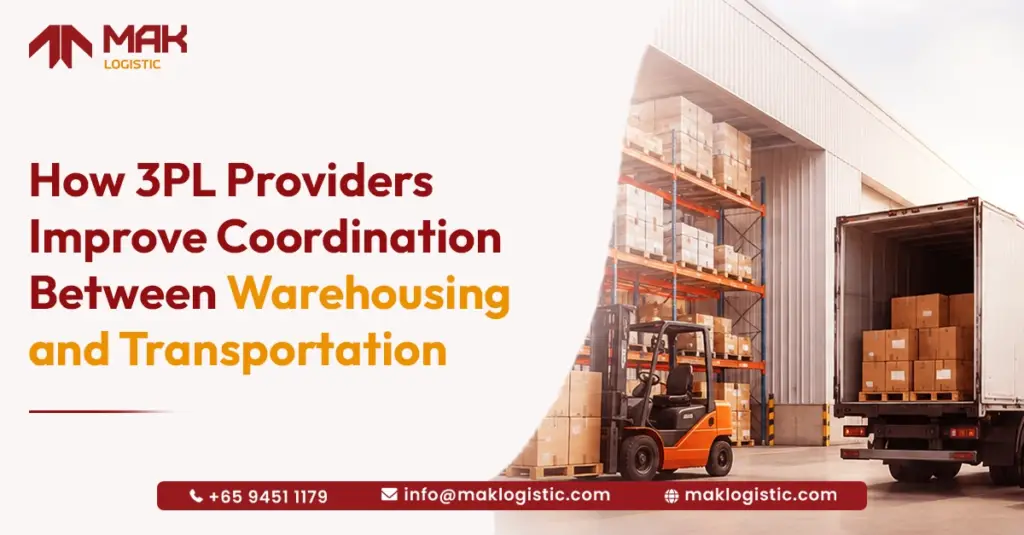
Warehousing and transportation are two closely connected parts of the supply chain. When these operations are managed separately, businesses may face delayed dispatches, vehicle waiting time, inventory discrepancies, higher logistics costs, and inconsistent delivery schedules.
This is where 3PL logistics services can make a difference.
A third party logistics (3PL) provider can coordinate activities such as warehouse storage, inventory management, order fulfilment, picking, packing, transportation, and delivery through a connected logistics process.
For businesses operating in Singapore, working with a third party logistics Singapore provider can simplify day-to-day logistics operations and create better coordination between the warehouse and transportation teams.
But how does this coordination actually work?
What Is the Relationship Between Warehousing and Transportation?
Warehousing and transportation perform different functions, but they depend on each other.
A warehouse stores and manages products until they are required for delivery, while transportation moves those products from the warehouse to customers, retailers, distributors, or other locations.
When the two operations are not properly coordinated, businesses can experience:
- Orders not being ready when vehicles arrive
- Unnecessary vehicle waiting time
- Delayed dispatches
- Poor inventory visibility
- Missed delivery schedules
- Additional transportation costs
- Communication gaps between warehouse and transport teams
Effective warehousing and transportation coordination ensures that products are prepared, dispatched, and transported according to planned schedules.
This is one of the key areas where a 3PL provider can add value.
How Do 3PL Providers Coordinate Warehousing and Transportation?
A 3PL provider connects warehouse activities with transportation planning instead of treating them as separate operations.
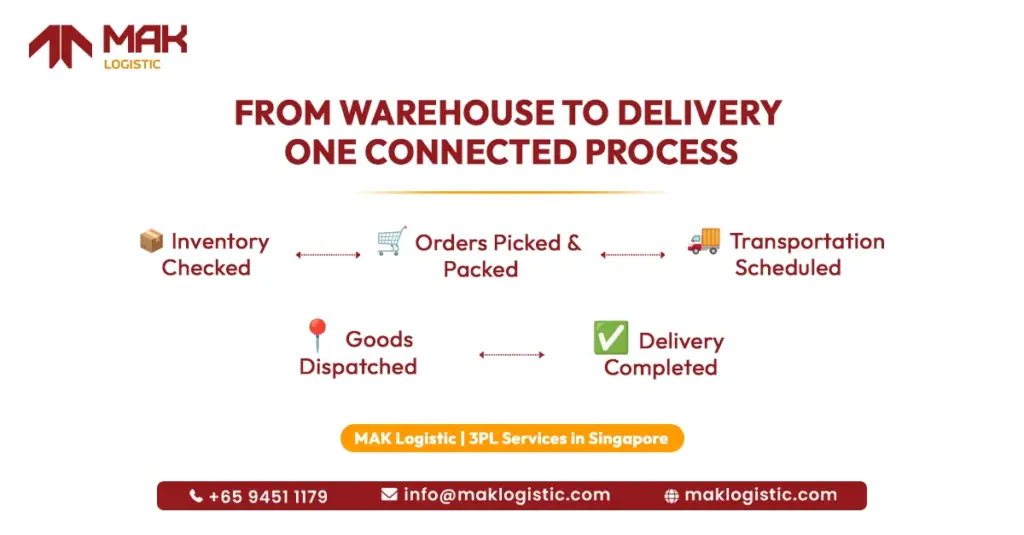
A typical coordinated workflow looks like this:
Order Received → Inventory Checked → Products Picked → Orders Packed → Dispatch Scheduled → Vehicle Assigned → Goods Collected → Delivery Completed
Each stage is connected to the next. When the warehouse team knows when transportation is scheduled, products can be prepared on time. Similarly, transport coordinators can plan vehicles according to the orders that are ready for dispatch.
This warehouse and transportation coordination can help create a smoother movement of products from storage to delivery.
How Does Inventory Visibility Improve Transportation Planning?
Accurate inventory information is essential for transportation planning.
Before a delivery vehicle is scheduled, the logistics team needs to know whether the required products are available and when they will be ready for dispatch.
A 3PL provider can coordinate warehouse inventory information with transportation requirements, helping businesses understand:
- Which products are available
- Where products are stored
- Which orders are ready for processing
- Which orders require priority
- When products are expected to be ready
- How many deliveries need to be scheduled
Better inventory visibility can reduce last-minute transportation changes and help warehouse teams prepare orders according to delivery requirements.
For businesses using warehouse storage Singapore solutions, this connection between inventory and transportation can be particularly useful when handling multiple products and frequent dispatches.
How Does Better Communication Between Warehouse and Transport Teams Reduce Delays?
Communication is an important part of logistics coordination.
Consider a simple example. An order is ready for collection at 2:00 PM, but the transportation team receives the dispatch information at 3:00 PM. The assigned vehicle may already be handling another delivery, creating an avoidable delay.
A 3PL provider can establish a structured communication process between:
- Warehouse teams
- Inventory coordinators
- Transport planners
- Drivers
- Customer service teams
- Business representatives
This allows everyone involved in the order fulfilment process to work with the same information.
Better communication can also help identify potential issues earlier, such as inventory shortages, changes in delivery requirements, or delays in order preparation.
How Can 3PL Providers Improve Vehicle Scheduling?
Vehicle scheduling needs to be aligned with warehouse operations.
If a vehicle arrives before an order is ready, the driver may have to wait. If the vehicle arrives too late, the delivery schedule may be affected.
A 3PL provider can coordinate vehicle scheduling based on factors such as:
- Order volume
- Product availability
- Warehouse processing time
- Delivery locations
- Vehicle capacity
- Delivery deadlines
- Dispatch requirements
This helps transportation teams plan vehicles according to actual warehouse requirements.
For companies looking for transportation services in Singapore, coordinated scheduling can help create a more organised process between order preparation and vehicle collection.
How Does Picking and Packing Coordination Improve Delivery Efficiency?
Transportation efficiency also depends on how quickly and accurately orders are prepared inside the warehouse.
Picking involves retrieving the correct products from storage, while packing prepares those products for dispatch.
If these activities are disconnected from transportation planning, vehicles may arrive before the orders are ready.
A coordinated process can look like this:
Order Confirmation → Picking → Packing → Dispatch Preparation → Vehicle Arrival → Loading → Departure
By connecting these stages, a 3PL provider can help warehouse teams prepare orders according to planned transportation schedules.
This is particularly important for e commerce businesses that process a large number of individual orders every day.
How Do 3PL Warehouse Services Support Transportation Coordination?
3PL warehouse services can include activities such as:
- Product receiving
- Inventory storage
- Stock management
- Order picking
- Packing
- Labelling
- Dispatch preparation
- Inventory reporting
When these services are connected with transportation planning, businesses can manage the movement of products more efficiently.
For example, once an order is confirmed, the warehouse team can check inventory, pick the required products, pack the order, and prepare it for the scheduled vehicle.
This reduces the need for businesses to separately coordinate every stage with different service providers.
How Can 3PL Providers Reduce Vehicle Waiting Time?
Vehicle waiting time can occur when transportation arrives before warehouse activities are completed.
For example, if a truck reaches a warehouse at 10:00 AM but the order is not ready until 11:00 AM, the vehicle and driver may spend an unnecessary hour waiting.
A coordinated logistics process can reduce this problem by aligning:
- Order confirmation
- Inventory checking
- Picking
- Packing
- Dispatch preparation
- Vehicle scheduling
- Loading
- Departure
When warehouse and transportation teams operate according to a shared schedule, vehicle collection can be better coordinated.
How Does Shipment Tracking Improve Logistics Coordination?
Visibility does not stop when an order leaves the warehouse.
Businesses also need to know whether products have been collected, are in transit, or have reached the delivery location.
Depending on the services provided, a 3PL operation can provide updates related to:
- Order processing
- Warehouse status
- Dispatch status
- Vehicle collection
- Delivery progress
- Completed deliveries
This information can help businesses respond quickly when delivery schedules change or an issue occurs.
For a logistics company in Singapore, providing clear communication throughout the warehouse-to-delivery process can be an important part of customer service.
How Do 3PL Providers Improve E Commerce Fulfilment?
E commerce businesses often have to manage hundreds or thousands of individual orders, making coordination between warehousing and transportation especially important.
A typical e commerce fulfilment process includes:
Inventory Storage → Order Received → Picking → Packing → Dispatch → Transportation → Delivery
A 3PL provider can coordinate these activities so that products move through the fulfilment process without unnecessary communication gaps.
Businesses can outsource activities such as:
- Warehouse storage
- Inventory management
- Pick and pack
- Order fulfilment
- Dispatch preparation
- Transportation
- Delivery coordination
This allows e commerce businesses to focus more on sales, customers, and product development while their logistics operations are managed by a specialist provider.
How Can 3PL Providers Help During Peak Demand?
Order volumes can increase significantly during festive periods, promotional campaigns, product launches, and major e commerce sales events.
When demand increases suddenly, both warehouse and transportation operations can come under pressure.
Without proper coordination, businesses may experience:
- Warehouse backlogs
- Picking delays
- Packing delays
- Vehicle shortages
- Missed delivery schedules
- Increased customer complaints
A 3PL provider can coordinate warehouse manpower, inventory processing, packing activities, dispatch schedules, and transportation requirements based on expected demand.
This helps businesses prepare their logistics operations before order volumes reach their peak.
How Does Integrated Logistics Improve Supply Chain Management?
Warehousing and transportation are only two parts of a larger supply chain.
Effective supply chain management Singapore businesses require coordination between inventory, warehousing, fulfilment, transportation, and delivery.
When these functions are connected, businesses can gain better visibility into how products move through their logistics network.
Supply chain visibility is becoming increasingly important for logistics businesses. Enterprise Singapore highlights digitalisation and supply chain visibility as important ways for businesses to improve operational efficiency, identify bottlenecks, and make better logistics decisions.
An integrated approach can support:
- Better inventory planning
- Faster order processing
- More organised transportation
- Improved delivery visibility
- Reduced communication gaps
- Easier logistics management
For businesses operating in Singapore, this can be particularly useful when managing local distribution or regional supply chain activities.
Why Is Warehousing and Transportation Coordination Important in Singapore?
Singapore has a well-developed logistics ecosystem and plays an important role in regional and global supply chains.
Singapore has a well-developed logistics ecosystem and plays an important role in regional and global supply chains. According to the Singapore Economic Development Board (EDB), Singapore was ranked first globally in the World Bank’s 2023 Logistics Performance Index and is home to a strong ecosystem of logistics and third-party logistics providers.
The World Bank’s 2023 Logistics Performance Index (LPI) evaluates logistics performance across areas including customs, infrastructure, international shipments, logistics competence, timeliness, and tracking and tracing. Singapore recorded an overall LPI score of 4.3 in the 2023 index.
For businesses operating in this environment, efficient coordination between warehouse operations and transportation can help create a more responsive logistics process.
This is relevant to businesses across industries such as:
- E commerce
- Retail
- FMCG
- Electronics
- Semiconductor
- Food and beverage
- Manufacturing
- Healthcare
- Wholesale and distribution
What Should Businesses Look for in a 3PL Provider in Singapore?
Choosing the right 3PL partner requires more than looking at warehouse space or transportation rates.
Businesses should consider whether the provider can coordinate multiple logistics activities through a connected process.
Important factors include:
1. Warehouse Capabilities
Check whether the provider offers suitable storage options and can manage the type and volume of products your business handles.
2. Inventory Management
Ask how inventory is received, stored, tracked, updated, and reported.
3. Fulfilment Services
Consider whether the provider can manage picking, packing, labelling, and dispatch preparation.
4. Transportation Capabilities
Review available vehicle options, delivery coverage, scheduling processes, and delivery requirements.
5. Technology and Visibility
Find out how order, inventory, warehouse, and delivery information is communicated and tracked.
6. Industry Experience
A provider familiar with your industry may better understand specific handling, storage, fulfilment, and delivery requirements.
7. Communication
Clear communication between your business, the warehouse team, and transportation team is essential for smooth operations.
How Does MAK Logistic Support Warehousing and Transportation in Singapore?
MAK Logistic provides logistics solutions for businesses in Singapore, covering warehousing, fulfilment, storage, and transportation requirements.
Our services include:
- 3PL services
- Warehouse storage
- Warehouse services
- E commerce fulfilment
- Pallet storage
- Racked storage
- Transportation services
- Warehouse manpower support
By connecting warehouse activities with transportation requirements, MAK Logistic helps businesses create a more organised flow from inventory storage to order fulfilment and delivery.
Whether you require short term or long term storage, e commerce fulfilment, pallet storage, or transportation support, an integrated approach can make logistics coordination easier.
What Is the Main Benefit of Using a 3PL Provider for Warehousing and Transportation?
The main benefit is better coordination across the logistics process.
Instead of managing warehouse operations and transportation separately, businesses can work with a 3PL provider that connects these activities.
The result is a more organised flow:
Inventory → Warehouse → Fulfilment → Dispatch → Transportation → Delivery
This can help businesses improve visibility, reduce avoidable delays, simplify logistics management, and create a more consistent customer experience.
For businesses searching for 3PL logistics services in Singapore, choosing a provider that can coordinate both warehousing and transportation can be an important step towards improving day-to-day supply chain operations.
Frequently Asked Questions About 3PL Warehousing and Transportation
How do 3PL providers coordinate warehousing and transportation?
They connect warehouse activities such as inventory management, picking, packing, and dispatch preparation with transportation scheduling, vehicle allocation, collection, and delivery.
What are the benefits of 3PL services in Singapore?
Businesses can benefit from coordinated logistics operations, better inventory visibility, simplified warehouse management, organised transportation planning, and improved fulfilment processes.
Can a 3PL provider manage both warehousing and transportation?
Yes. Many providers offer integrated logistics solutions that combine warehouse operations with transportation and delivery services.
Is 3PL suitable for e commerce businesses?
Yes. E commerce businesses can use 3PL services for inventory storage, order fulfilment, picking, packing, dispatch, and transportation.
What is the difference between warehousing and transportation?
Warehousing involves storing and managing products, while transportation involves moving products between locations. A 3PL provider can coordinate both functions as part of an integrated logistics process.
Why should businesses choose a 3PL provider in Singapore?
A local 3PL provider can help businesses coordinate storage, fulfilment, transportation, and delivery according to their operational requirements in Singapore.
Conclusion
Warehousing and transportation are closely connected activities that influence how efficiently products move from storage to customers.
When these functions are managed separately, businesses may face communication gaps, vehicle waiting time, dispatch delays, and limited visibility.
A professional 3PL provider in Singapore can connect warehouse storage, inventory management, fulfilment, dispatch, transportation, and delivery into a more coordinated process.
For businesses looking to improve their logistics operations, MAK Logistic provides integrated warehousing, fulfilment, storage, and transportation solutions in Singapore.
Need help coordinating your warehousing and transportation operations? Contact MAK Logistic to discuss your 3PL requirements in Singapore.