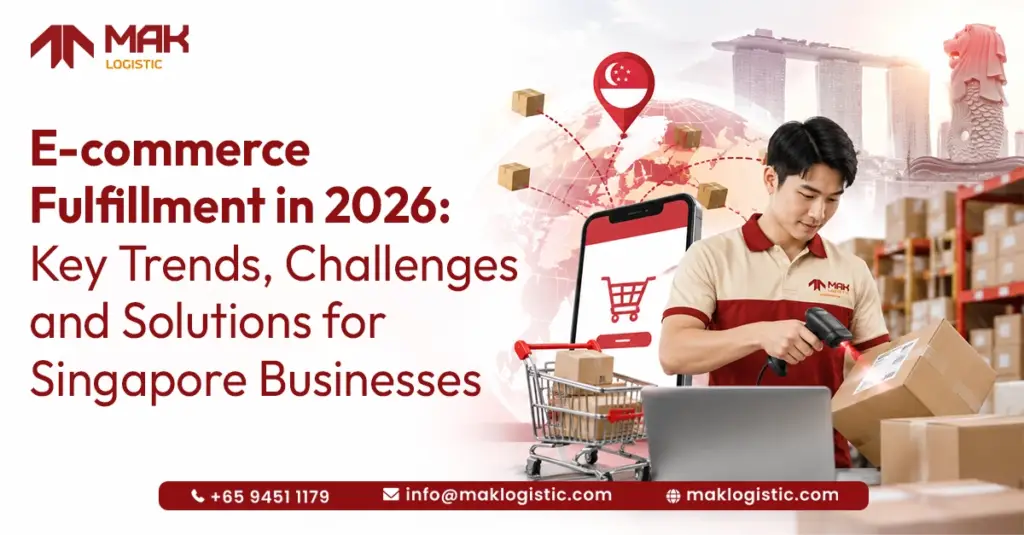
E-commerce businesses in Singapore are under increasing pressure to process orders accurately, manage inventory efficiently and deliver products on time. As online shopping expectations evolve, businesses need fulfilment operations that can adapt to changing order volumes, customer demands and operating costs.
In 2026, e-commerce fulfillment in Singapore is about more than storing products and shipping orders. It involves inventory visibility, efficient picking and packing, reliable transportation, returns management and the ability to scale without disrupting daily operations.
For small online retailers, growing e-commerce brands and established businesses, choosing the right fulfilment strategy can make a meaningful difference to customer satisfaction and operational efficiency.
In this guide, we explore the key e-commerce fulfilment trends in 2026, the challenges Singapore businesses face and practical solutions to improve warehouse and order fulfilment operations.
What Is E-commerce Fulfillment?
E-commerce fulfilment is the process of receiving, storing, picking, packing and delivering products purchased through an online store or marketplace. It also includes inventory management, order tracking and handling product returns.
A typical e-commerce fulfilment process involves:
- Inventory receiving: Products arrive at the warehouse and are checked against the relevant records.
- Warehouse storage: Products are organised and stored for efficient access.
- Order processing: Customer orders are received and prepared for fulfilment.
- Picking and packing: Warehouse staff select the correct products, check quantities and pack orders securely.
- Dispatch and transportation: Completed orders are prepared for collection and delivery.
- Returns management: Returned products are inspected and processed according to the business’s return policy.
An effective e-commerce fulfilment service in Singapore helps businesses coordinate these activities while maintaining stock accuracy and a consistent customer experience.
What Are the Key E-commerce Fulfillment Trends in 2026?
Technology adoption, operational efficiency and customer expectations are shaping how businesses approach fulfilment. Singapore’s logistics sector is also investing in digitalisation and automation to improve productivity and resource utilisation. The Infocomm Media Development Authority’s Logistics Industry Digital Plan outlines digital solutions that logistics SMEs can consider as their operations develop.
Here are six trends businesses should pay attention to in 2026.
1. AI-Powered Inventory Forecasting
Artificial intelligence and data analytics are helping businesses make more informed inventory decisions. By reviewing historical sales, seasonal demand and order patterns, businesses can improve their understanding of which products may need replenishment.
Better forecasting can help reduce excess stock, minimise stockouts and support more effective warehouse planning.
How businesses can apply this trend:
- Review historical sales and seasonal demand.
- Identify fast-moving and slow-moving products.
- Set appropriate reorder levels for important items.
- Use available inventory data to support purchasing decisions.
AI tools should complement accurate stock records and operational knowledge rather than replace them entirely.
2. Warehouse Automation and Digitalisation
Warehouse automation is becoming increasingly relevant as businesses look for ways to improve productivity and manage labour constraints. Singapore’s logistics industry is exploring automated systems, digital workflows and smarter inventory management to make better use of available resources.
For e-commerce businesses, warehouse technology may include barcode scanning, warehouse management systems (WMS), automated stock updates and digital order processing.
These solutions can help reduce manual data entry, improve stock visibility and make it easier to identify fulfilment errors.
However, businesses should select technology based on their order volume, budget and operational requirements. A simple barcode-based process may be more appropriate for a small retailer than a complex automated warehouse system.
3. Faster and More Flexible Order Fulfillment
Customers increasingly expect clear delivery information, accurate orders and reliable fulfilment. For online retailers, this creates pressure to process orders efficiently without compromising accuracy.
Faster fulfilment does not always require expensive automation. Businesses can also improve speed by organising products strategically, reducing unnecessary warehouse movement and establishing clear picking and packing procedures.
Useful improvements include:
- Storing frequently ordered products in accessible locations.
- Setting daily order processing cut-off times.
- Standardising packing procedures.
- Coordinating warehouse dispatch with transportation schedules.
- Monitoring delayed and incomplete orders.
A well-organised fulfilment process helps businesses balance delivery expectations with operational costs.
4. Integrated Inventory and Order Management
Managing online store orders, marketplace sales and warehouse stock through disconnected systems can create unnecessary complexity. Stock figures may become inconsistent, orders may be missed and employees may spend additional time reconciling records.
Integrated inventory and order management can improve visibility across sales channels and warehouse operations.
Businesses should aim to maintain a consistent view of available stock, orders awaiting processing, dispatched orders and returned products. Where suitable systems are available, connecting sales channels with warehouse operations can reduce manual updates and improve coordination.
5. More Attention to Returns Management
Product returns are an important part of e-commerce operations. Without a clear process, returned items can remain uninspected, saleable inventory may not be updated promptly and refunds or exchanges may take longer to process.
A structured returns process should define how returned products are received, inspected, classified and recorded.
For example, products in resaleable condition may be returned to available inventory, while damaged or incomplete items may require separate handling.
Efficient returns management helps businesses maintain better inventory visibility and understand recurring issues, such as incorrect product descriptions or unsuitable packaging.
6. Flexible Warehousing and Third-Party Logistics
As e-commerce businesses grow, their storage and fulfilment needs can change quickly. Seasonal promotions, new product launches and fluctuating order volumes may make it difficult to plan warehouse space and staffing requirements.
Outsourcing selected logistics activities to a third-party logistics (3PL) provider can give businesses access to warehousing, inventory handling, picking and packing, and transportation support without requiring them to manage every activity internally.
The right arrangement depends on order volumes, product characteristics, service requirements and total costs. Businesses should assess whether an external fulfilment partner can provide the flexibility and operational visibility they need.
What Are the Main E-commerce Fulfillment Challenges in Singapore?
Although e-commerce creates growth opportunities, fulfilment operations can become more complicated as a business expands. Singapore businesses need to consider warehouse space, labour, delivery coordination and inventory accuracy when planning their operations.
1. Rising Warehouse and Operating Costs
Warehouse space, labour, packaging materials and transportation contribute to fulfilment expenses. These costs can become harder to manage when order volumes fluctuate or products occupy storage space for extended periods.
Solution: Review warehouse utilisation, identify slow-moving stock and monitor the cost of processing each order. Compare in-house fulfilment with outsourced options by considering the full operating cost, not just the storage rate.
2. Inventory Inaccuracies
When physical stock does not match recorded inventory, businesses may accept orders for unavailable products or delay dispatch while staff investigate discrepancies.
Solution: Conduct regular stock counts, record every inventory movement and establish clear procedures for receiving, picking, packing and returns. Barcode scanning and warehouse management tools can provide additional control where appropriate.
3. Labour Shortages During Peak Periods
Sales campaigns, festive seasons and promotional events can create sudden increases in order volumes. If staffing levels do not match demand, picking, packing and dispatch may fall behind schedule.
Solution: Forecast busy periods early, plan staff requirements and establish procedures for managing order backlogs. Businesses can also explore flexible warehouse manpower support when additional operational capacity is required.
4. Delivery Delays and Poor Coordination
Even when orders are packed correctly, delays can occur if dispatch schedules, collection arrangements and transportation are not coordinated effectively.
Solution: Set clear dispatch cut-off times, communicate order readiness to transportation partners and monitor recurring delivery issues. Businesses should also review delivery performance to identify avoidable delays.
5. Picking, Packing and Order Errors
Incorrect products, missing items and unsuitable packaging can lead to customer complaints, returns and additional fulfilment expenses.
Solution: Use standard picking lists, verify products before sealing packages and apply suitable packaging guidelines. Track error rates to identify whether problems arise from stock locations, product identification or staff procedures.
6. Managing Growth Without Disrupting Operations
A fulfilment process that works for 20 orders a day may not be suitable for 200 orders a day. As sales increase, businesses may outgrow their storage arrangements, staffing capacity or existing order management process.
Solution: Review fulfilment capacity regularly. Assess available storage, average order volume, peak demand, staffing needs and transportation arrangements before expanding. A scalable fulfilment strategy helps businesses prepare for growth without making unnecessary investments too early.
How Can Singapore Businesses Improve E-commerce Fulfillment in 2026?
Businesses do not need to implement every new technology or change their entire supply chain at once. A practical improvement plan starts with identifying the biggest operational problems and addressing them systematically.
1. Map the Entire Fulfillment Process
Document each step from inventory receiving to final dispatch. Identify where orders wait, where information is entered manually and where errors occur most frequently.
This provides a clearer picture of the changes that will have the greatest operational impact.
2. Track the Right Fulfillment Metrics
Use measurable indicators to understand operational performance. Useful metrics include:
- Order accuracy rate: The percentage of orders processed correctly.
- Order processing time: The time taken to prepare an order for dispatch.
- Inventory accuracy: How closely recorded stock matches physical stock.
- On-time dispatch rate: The percentage of orders dispatched by the agreed cut-off.
- Return rate: The proportion of orders or products returned.
- Fulfillment cost per order: The total relevant fulfilment cost divided by the number of orders processed.
Review these metrics regularly to identify trends and prioritise improvements.
3. Improve Warehouse Layout and Stock Organisation
A warehouse layout should support efficient product movement and easy stock identification. Frequently ordered products should be accessible, storage locations should be clearly labelled, and receiving and dispatch activities should be organised to minimise unnecessary movement.
The best arrangement depends on product size, turnover, handling requirements and order patterns.
4. Establish Standard Operating Procedures
Clear procedures help warehouse teams perform repetitive tasks consistently. Document how staff should receive products, update inventory, pick orders, check quantities, pack items and process returns.
Standard operating procedures are particularly useful when onboarding new employees or bringing in additional manpower during busy periods.
5. Review In-house Fulfillment Versus Outsourcing
Managing fulfilment internally may offer direct control over processes, but it also requires businesses to manage storage, manpower, systems and daily operations.
An outsourced arrangement may provide access to established warehouse processes and logistics support. Before deciding, compare the following:
- Total cost per order.
- Warehouse storage requirements.
- Expected daily and seasonal order volumes.
- Picking, packing and inventory management capabilities.
- Transportation coordination.
- Flexibility to scale operations.
- Reporting, communication and service expectations.
The objective is to select a fulfilment model that suits the business’s current requirements while supporting future growth.
How Can a 3PL Provider Support E-commerce Fulfillment in Singapore?
A third-party logistics provider can support businesses by managing selected activities across the fulfilment process. Depending on the agreed service scope, these activities may include warehouse storage, inventory handling, order picking, packing, dispatch preparation and transportation coordination.
Working with a 3PL provider may be particularly useful for businesses that lack sufficient warehouse space, need additional operational capacity or want to reduce the time spent coordinating daily logistics.
Before selecting a provider, businesses should confirm its service capabilities, pricing structure, inventory reporting process, order cut-off times and arrangements for peak periods.
It is also important to understand which responsibilities remain with the business. Clear agreements help prevent misunderstandings about stock discrepancies, order processing, returns and delivery performance.
Singapore’s logistics ecosystem continues to develop digital and operational capabilities. Businesses can explore the Singapore Economic Development Board’s overview of logistics and supply chain management to understand the broader logistics environment in which fulfilment operations take place.
How MAK Logistic Supports E-commerce Fulfillment
MAK Logistic supports businesses in Singapore with logistics services designed to help coordinate warehousing, inventory handling and product movement.
For e-commerce businesses looking to improve their fulfilment operations, relevant support may include:
- Warehouse storage: Space to store products based on business requirements and agreed arrangements.
- Inventory handling: Support for organising and managing stored products.
- Picking and packing: Operational support for preparing customer orders.
- E-commerce fulfillment: Coordination of warehouse activities involved in preparing orders for dispatch.
- Transportation services: Support for moving products between relevant locations, subject to the agreed service scope.
- Flexible manpower supply: Additional warehouse staffing support to help businesses manage changing operational requirements.
The right combination of services depends on each business’s order volume, storage needs and fulfilment workflow.
If your current fulfilment process is becoming difficult to manage, reviewing your storage, manpower and transportation arrangements can help identify practical opportunities to improve efficiency.
Looking for e-commerce fulfillment support in Singapore?
Contact MAK Logistic to discuss your warehousing and logistics requirements.
Phone/WhatsApp: +65 9451 1179
Email: info@maklogistic.com
Website: https://maklogistic.com/
Frequently Asked Questions About E-commerce Fulfillment in Singapore
1. What is e-commerce fulfillment in Singapore?
E-commerce fulfilment in Singapore involves receiving and storing inventory, processing online orders, picking and packing products, preparing dispatches and coordinating delivery. Depending on the arrangement, businesses can manage these activities internally or outsource selected tasks to a third-party logistics provider.
2. What are the main e-commerce fulfillment trends in 2026?
Key trends include AI-supported inventory forecasting, warehouse digitalisation, automation, integrated inventory management, improved returns handling and flexible third-party logistics services. Businesses should adopt solutions based on their order volume, budget and operational needs.
3. How can a business reduce e-commerce fulfillment costs?
Businesses can review storage utilisation, improve inventory accuracy, organise warehouse layouts, reduce picking and packing errors, monitor cost per order and plan staffing around demand. Comparing the total cost of in-house and outsourced fulfilment can also help identify a suitable operating model.
4. When should an e-commerce business outsource fulfillment?
Outsourcing may be worth considering when order volumes increase, warehouse space becomes insufficient, staffing is difficult to manage or fulfilment tasks take time away from core business activities. Businesses should compare provider capabilities, pricing, flexibility and reporting before making a decision.
5. What should businesses look for in an e-commerce fulfillment provider in Singapore?
Businesses should evaluate warehouse facilities, inventory handling procedures, picking and packing capabilities, transportation coordination, pricing transparency, scalability and communication. They should also confirm the exact services included in the agreement and how performance will be monitored.
Conclusion
E-commerce fulfilment in 2026 requires Singapore businesses to balance speed, accuracy, flexibility and cost control. Inventory visibility, organised warehouse processes, reliable transportation and effective returns management all contribute to a more dependable fulfilment operation.
Rather than adopting every new technology, businesses should focus on the improvements that address their most pressing challenges. Reviewing operational metrics, preparing for demand fluctuations and evaluating suitable 3PL support can help create a fulfilment process that grows with the business.
MAK Logistic can support your warehousing and logistics requirements in Singapore. Contact our team to discuss a fulfilment arrangement suited to your business.