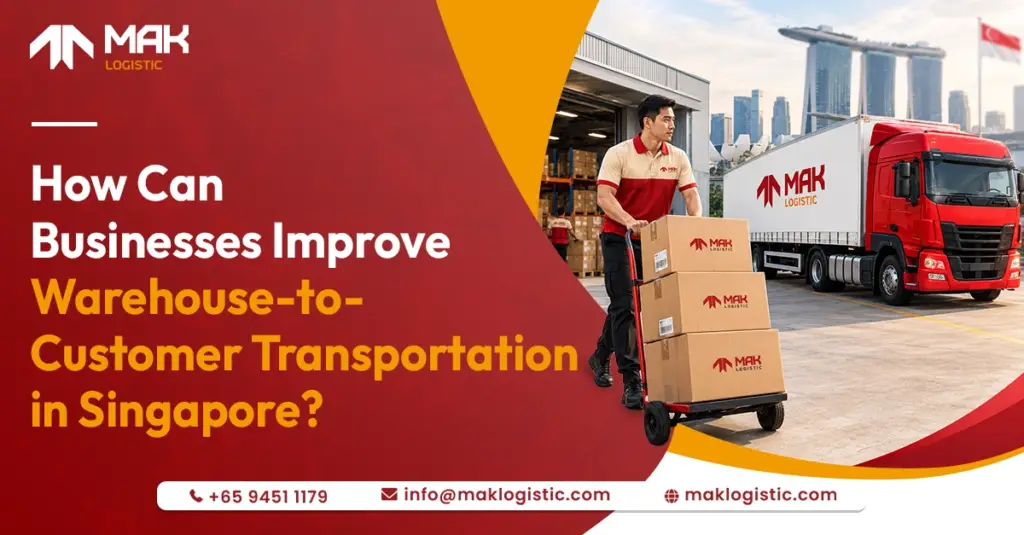
For businesses that store and distribute products in Singapore, transportation between the warehouse and the customer is an important part of the overall supply chain.
Even when warehouse operations are well organised, delays can occur if transportation planning, order preparation, vehicle scheduling, or delivery coordination is not handled efficiently.
So, how can businesses improve warehouse-to-customer transportation in Singapore?
Better coordination between warehousing, order fulfillment, transportation, inventory management, and delivery operations can help businesses reduce delays, improve visibility, and provide a more reliable customer experience.
What Is Warehouse-to-Customer Transportation?
Warehouse-to-customer transportation refers to the movement of products from a warehouse or fulfillment facility to the final customer or delivery location.
The process generally involves:
- Receiving and storing products in the warehouse
- Processing customer orders
- Picking and packing products
- Preparing orders for dispatch
- Assigning transportation
- Delivering products to the customer
- Managing delivery confirmation or returns
For e-commerce businesses, this process is closely connected to order fulfillment and last-mile delivery.
Why Is Warehouse-to-Customer Transportation Important?
Transportation is more than simply moving products from one location to another.
An inefficient transportation process can result in:
- Delivery delays
- Higher transportation costs
- Poor customer experience
- Missed delivery windows
- Increased handling
- Difficulties tracking orders
- Higher pressure on warehouse teams
For businesses operating in Singapore, efficient transportation can help connect warehouse operations with customers more smoothly.
How Can Businesses Improve Warehouse-to-Customer Transportation?
1. Improve Coordination Between Warehouse and Transportation Teams
One of the most important steps is improving communication between warehouse and transportation operations.
Orders should be ready for collection at the planned time, while transportation teams should have accurate information about:
- Delivery addresses
- Order quantities
- Delivery requirements
- Collection schedules
- Special handling requirements
- Delivery priorities
Better coordination helps reduce waiting time and unnecessary vehicle movements.
2. Improve Order Picking and Packing Accuracy
Transportation efficiency begins inside the warehouse.
If the wrong product is picked or an order is packed incorrectly, the delivery process can be affected by returns, replacements, and additional transportation.
Businesses should establish clear picking and packing processes and ensure orders are checked before dispatch.
Accurate picking and packing in Singapore can therefore contribute to smoother warehouse-to-customer transportation.
3. Use Proper Delivery Planning
Delivery planning helps businesses organise transportation according to order locations, delivery schedules, and vehicle availability.
Businesses can consider:
- Grouping deliveries by location
- Planning suitable delivery sequences
- Matching vehicle capacity with order volume
- Prioritising time-sensitive deliveries
- Scheduling collections and dispatches properly
For businesses handling multiple daily deliveries, structured planning can help reduce unnecessary travel and improve vehicle utilisation.
4. Maintain Accurate Inventory Information
Transportation problems can sometimes begin with inaccurate inventory information.
If the system shows that a product is available when it is actually out of stock, an order may be processed unnecessarily or delayed.
Accurate inventory management helps businesses know:
- What products are available
- Where products are stored
- How much stock is available
- Which orders can be fulfilled
- When inventory needs replenishment
Better inventory visibility supports more reliable order fulfillment and transportation planning.
5. Improve Warehouse Dispatch Processes
The transition from warehouse to transportation should be organised.
Before a vehicle arrives, businesses should ensure that orders are:
- Picked
- Packed
- Labelled
- Checked
- Sorted
- Staged for collection
A well-organised dispatch area can reduce loading delays and help transportation teams collect orders more efficiently.
6. Use Technology for Better Visibility
Technology can improve visibility across warehouse and transportation operations.
Depending on the business, systems can help monitor:
- Inventory
- Orders
- Dispatch status
- Delivery progress
- Vehicle information
- Proof of delivery
Warehouse Management Systems (WMS), Inventory Management Systems (IMS), and transportation management tools can help businesses make better operational decisions.
Technology does not replace good processes, but it can make them easier to monitor and manage.
7. Choose the Right Transportation Solution
Different products and businesses may require different transportation arrangements.
For example, businesses may need:
- General transportation
- Warehouse-to-warehouse transportation
- Warehouse-to-customer delivery
- Airport-to-warehouse transportation
- Cold chain transportation
- Specialised transportation for electronics or semiconductor products
The transportation solution should match the product, delivery requirements, volume, and operating schedule.
8. Improve Last-Mile Delivery Coordination
The final stage of transportation has a direct impact on customer experience.
Businesses should pay attention to:
- Accurate delivery addresses
- Delivery scheduling
- Customer communication
- Delivery tracking
- Proof of delivery
- Failed delivery management
- Returns
For e-commerce businesses, a well-managed last-mile delivery process in Singapore can help create a more reliable customer experience.
9. Use Flexible Transportation During Peak Demand
Transportation requirements can increase during:
- Promotional campaigns
- Festive periods
- Product launches
- Seasonal demand
- Major e-commerce sales events
Businesses that rely on a fixed transportation capacity may struggle during sudden increases in order volume.
Flexible transportation support allows businesses to adjust delivery capacity according to demand.
10. Work With a 3PL Provider
Managing warehousing and transportation separately can create additional coordination challenges.
A 3PL provider can connect services such as:
- Warehouse storage
- Inventory handling
- Picking and packing
- Order fulfillment
- Transportation
- Delivery
- Returns management
This can give businesses a more coordinated logistics process instead of managing each activity independently.
What Are the Benefits of Improving Warehouse-to-Customer Transportation?
A more organised transportation process can help businesses achieve several operational benefits.
Faster Order Movement
Better coordination between warehouse and transportation teams can reduce unnecessary waiting and handling.
Better Delivery Reliability
Improved planning and dispatch processes can help businesses meet delivery schedules more consistently.
Greater Visibility
Tracking orders and transportation activity can give businesses better visibility over where products are in the fulfillment process.
Better Customer Experience
Reliable deliveries can contribute to greater customer satisfaction and confidence.
Improved Operational Efficiency
When warehouse and transportation activities are better connected, businesses can reduce unnecessary duplication and improve resource utilisation.
How Does Warehouse Storage Affect Transportation?
Warehouse storage and transportation are closely connected.
The location and organisation of inventory can affect how quickly orders are picked, packed, staged, and dispatched.
For example, fast-moving products should be easy to access, while organised storage locations can reduce unnecessary movement within the warehouse.
Businesses using warehouse storage in Singapore should therefore consider not only how much space they have, but also how their storage setup supports order fulfillment and transportation.
How Can E-commerce Businesses Improve Warehouse-to-Customer Delivery?
E-commerce businesses often manage large numbers of individual orders rather than a smaller number of bulk shipments.
This makes coordination particularly important.
An effective process should connect:
Inventory → Picking → Packing → Dispatch → Transportation → Last-Mile Delivery → Customer
Using an ecommerce fulfillment service in Singapore can help businesses coordinate warehouse storage, inventory handling, order processing, picking and packing, and transportation through one connected operation.
Should Businesses Outsource Warehouse-to-Customer Transportation?
Outsourcing can be useful when businesses:
- Have increasing delivery volumes
- Lack their own transportation resources
- Need flexible delivery capacity
- Are expanding their e-commerce operations
- Experience frequent delivery delays
- Want to focus more on their core business
- Need combined warehousing and transportation support
However, the right approach depends on the company’s order volume, product type, delivery requirements, and operating model.
How Can Businesses Choose a Transportation Partner in Singapore?
Before selecting a logistics or transportation provider, businesses should consider:
Service coverage: Can the provider support the required delivery locations and transportation requirements?
Flexibility: Can transportation capacity increase when demand rises?
Operational capability: Can the provider coordinate transportation with warehouse and fulfillment activities?
Tracking and visibility: Does the business have access to relevant delivery information?
Experience: Does the provider understand the company’s product and delivery requirements?
Scalability: Can the provider continue supporting the business as order volumes grow?
A transportation partner should be evaluated based on the overall logistics requirement rather than transportation alone.
How Does MAK Logistic Support Warehouse-to-Customer Transportation?
MAK Logistic provides transportation and logistics support for businesses in Singapore.
Our services can support different stages of the supply chain, including:
- Warehouse-to-customer transportation
- Warehouse-to-warehouse transportation
- Airport-to-warehouse transportation
- Cold chain transportation
- Transportation for electronics and semiconductor products
- E-commerce fulfillment
- Warehouse storage
- Inventory handling
- Picking and packing
By connecting warehousing, fulfillment, and transportation services, MAK Logistic helps businesses create a more coordinated logistics operation.
Frequently Asked Questions
1. What is warehouse-to-customer transportation?
Warehouse-to-customer transportation is the process of moving products from a warehouse or fulfillment facility to the final customer or delivery location.
2. How can businesses reduce warehouse-to-customer delivery delays?
Businesses can reduce delays by improving inventory accuracy, picking and packing, dispatch planning, transportation scheduling, delivery coordination, and communication between warehouse and transportation teams.
3. Is warehouse-to-customer transportation important for e-commerce?
Yes. E-commerce businesses handle many individual customer orders, making efficient fulfillment and last-mile transportation important for meeting customer delivery expectations.
4. Can a 3PL provider manage warehouse and transportation services?
Yes. A 3PL provider can combine services such as warehouse storage, inventory handling, order fulfillment, picking and packing, transportation, and returns management.
5. What transportation services can businesses use in Singapore?
Depending on their requirements, businesses may use warehouse-to-customer transportation, warehouse-to-warehouse transportation, airport-to-warehouse transportation, cold chain transportation, and specialised transportation for certain products.
Conclusion
Warehouse-to-customer transportation is an important link between inventory and the end customer.
Businesses can improve transportation efficiency by coordinating warehouse and delivery operations, improving picking and packing accuracy, maintaining accurate inventory, planning deliveries effectively, using technology, and choosing transportation capacity that matches demand.
For businesses that want to simplify their logistics operations, combining warehouse storage, e-commerce fulfillment, and transportation services in Singapore can provide a more connected approach.
MAK Logistic supports businesses with warehousing, fulfillment, manpower, and transportation solutions designed around their operational requirements.
Looking for reliable warehouse and transportation support in Singapore?
📞 +65 9451 1179
📧 info@maklogistic.com
🌐 maklogistic.com