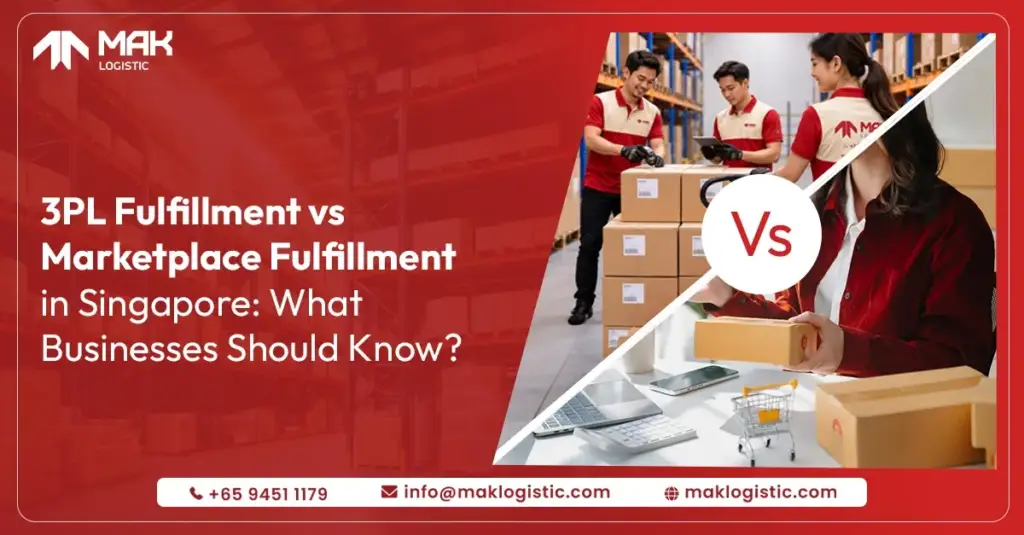
If you sell products online in Singapore, fulfillment can become one of the biggest factors affecting customer satisfaction, operating costs, and business growth. Many businesses reach a point where they must choose between 3PL fulfillment and marketplace fulfillment. Whether you are working with an ecommerce fulfillment service in Singapore or using a marketplace’s logistics network, understanding the differences is essential for long term success.
Both models can work, but they serve different business goals. This guide explains the key differences, the advantages and limitations of each approach, and when businesses in Singapore should consider moving to a dedicated 3PL partner such as MAK Logistic.
What is the difference between 3PL fulfillment and marketplace fulfillment?
| 3PL fulfillment | A third party logistics provider stores, picks, packs, and ships orders for your business across multiple sales channels. |
| Marketplace fulfillment | A marketplace such as Amazon, Lazada, or Shopee stores and ships orders that are placed through its own platform. |
In Singapore, marketplace fulfillment is often the fastest way to start selling online, while 3PL fulfillment is usually better for brands that want more control, multi-channel sales, and long-term scalability.
What Is 3PL Fulfillment in Singapore?
3PL stands for Third Party Logistics. A 3PL provider in Singapore handles warehousing, inventory management, order processing, packaging, shipping, and returns on behalf of a business.
With a 3PL model, you own the customer relationship and the inventory, while the logistics provider manages the operational side.
A professional 3PL company in Singapore helps businesses manage warehousing, inventory control, order processing, shipping, and returns through a centralized logistics operation. Many growing brands rely on a trusted ecommerce fulfillment service in Singapore to improve efficiency and deliver a better customer experience.
Typical 3PL services include:
- Warehousing and storage
- Inventory tracking
- Order picking and packing
- Courier management
- Returns handling
- Integration with e-commerce platforms and ERP systems
For example, a Singapore-based beauty brand selling through Shopify, Lazada, Shopee, and its own retail stores can centralize inventory with a 3PL provider and fulfill orders from a single warehouse.
What Is Marketplace Fulfillment?
Marketplace fulfillment is a service offered by e-commerce marketplaces. The marketplace stores your inventory and ships orders placed through that marketplace.
Examples include:
- Amazon FBA
- Lazada Fulfillment
- Shopee Fulfillment Service
This model is convenient for sellers who primarily operate within one marketplace ecosystem.
Key takeaway
Marketplace fulfillment is usually the fastest way to start selling online.
A marketplace stores and ships orders that originate on its own platform, while a 3PL can support multiple sales channels from one inventory pool.
3PL Fulfillment vs Marketplace Fulfillment: Key Differences
| Factor | 3PL Fulfillment | Marketplace Fulfillment |
| Sales channels | Multiple channels | Usually limited to the marketplace |
| Branding | Custom packaging and inserts | Marketplace controlled packaging |
| Customer data | Greater ownership of customer data | Limited customer data access |
| Inventory flexibility | Centralized inventory across channels | Inventory tied to marketplace systems |
| Shipping options | Choose couriers and service levels | Marketplace shipping network |
| International expansion | Can support multiple markets | Depends on marketplace coverage |
| Operational control | Higher control | Lower control |
Why Many Singapore Brands Start with Marketplace Fulfillment ?
Marketplace fulfillment offers several advantages for early-stage sellers.
Benefits
- Fast setup with minimal logistics infrastructure.
- Access to the marketplace’s delivery network.
- Potential eligibility for marketplace programs such as faster shipping badges.
- Simplified operations for single-channel sellers.
For a new seller on Shopee or Lazada, these benefits can reduce the complexity of launching an online business.
When Marketplace Fulfillment Becomes Limiting ?
As businesses grow, marketplace fulfillment can create operational challenges.
Common limitations
- Inventory is often separated by marketplace.
- Custom packaging and brand experience are limited.
- Customer data access may be restricted.
- Expanding to additional sales channels becomes more complex.
- Businesses become more dependent on marketplace policies and fees.
A common example is a Singapore electronics seller that starts on one marketplace, then launches its own Shopify store. Managing separate inventory pools and fulfillment processes can quickly become inefficient.
Why Established Brands Often Move to 3PL Fulfillment?
Many growing businesses eventually shift to a 3PL model because it offers greater operational flexibility.
Common reasons to switch
- One inventory pool serving multiple channels.
- Branded packaging and unboxing experiences.
- Integration with e-commerce platforms and business systems.
- More control over shipping methods and service levels.
- Better support for B2B and retail distribution alongside e-commerce.
At MAK Logistic, we frequently work with brands that outgrow marketplace-only fulfillment and need a centralized logistics operation in Singapore.
Real World Example
Case study: Singapore lifestyle brand
A lifestyle brand in Singapore initially used marketplace fulfillment for all orders. Sales increased, and the company expanded to its own website and corporate gifting channel.
The brand then faced three problems:
- Inventory was split across systems.
- Packaging could not be customized for corporate orders.
- Returns management became difficult.
By moving to a centralized 3PL warehouse, the brand was able to fulfill orders from multiple channels, introduce branded packaging, and improve inventory visibility.
Result: Fewer stock discrepancies and a smoother customer experience across all channels.
Cost Considerations
Cost is often a deciding factor, but the cheapest option depends on volume and business complexity.
Marketplace fulfillment may be cheaper when:
- You sell through a single marketplace.
- Order volumes are relatively low.
- You do not need custom packaging or multi-channel fulfillment.
3PL fulfillment may be more cost-effective when:
- You sell across multiple channels.
- You need branded packaging.
- You require inventory consolidation.
- You want more control over shipping and customer experience.
The key is to compare total logistics cost, not just storage or shipping fees. This includes labor, inventory carrying costs, returns processing, packaging, and operational overhead.
Singapore context
Why this matters in Singapore?
Singapore’s e-commerce market continues to grow, and customer expectations for fast delivery are rising. According to government and industry data, digital commerce remains a significant growth area for local businesses.
Questions to Ask Before Choosing a Fulfillment Model
Ask yourself:
- Do you sell on multiple platforms?
- Do you want to build your own brand experience?
- Do you need access to customer and inventory data?
- Are you planning to expand beyond a single marketplace?
- Do you require B2B, retail, or wholesale fulfillment in addition to e-commerce?
If the answer is “yes” to several of these questions, a 3PL solution is often the better long-term fit.
How MAK Logistic Supports Growing Businesses in Singapore?
MAK Logistic provides fulfillment and warehousing services for businesses that need more than marketplace-only logistics. Our Singapore operations support inventory management, order fulfillment, shipping coordination, and returns handling across multiple sales channels.
We work with brands that want:
- Centralized inventory management.
- Multi-channel fulfillment.
- Custom packaging and branded experiences.
- Better operational visibility.
- Scalable logistics support as order volumes grow.
Final Thoughts
There is no single best fulfillment model for every business.
Marketplace fulfillment in Singapore is often ideal for new sellers focused on one platform and looking for a fast, simple setup.
3PL fulfillment in Singapore becomes increasingly valuable when a business expands across channels, wants stronger brand control, and needs centralized logistics operations.
For many Singapore brands, the transition from marketplace fulfillment to a dedicated 3PL partner marks the point where logistics shifts from a basic operational task to a strategic growth function.If your business is reaching that stage, MAK Logistic can help you evaluate the right fulfillment model and build a logistics setup that supports long-term growth in Singapore.