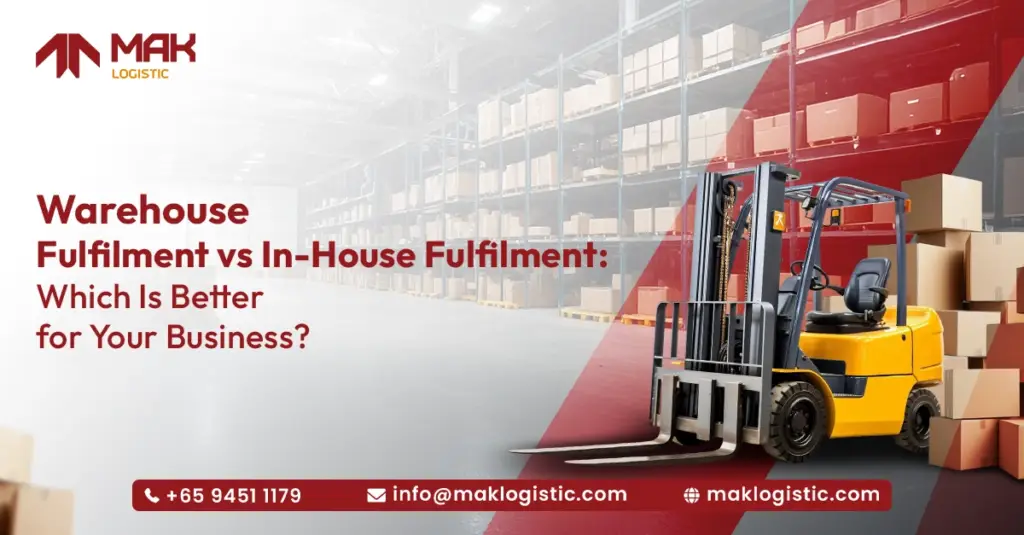
As eCommerce and global trade continue to grow, businesses face one critical decision how to manage order fulfilment. Should you handle everything internally or outsource to a professional warehouse fulfilment partner
At MAK Logistic Singapore, we have worked with startups, SMEs, and scaling brands across Southeast Asia. From this hands-on experience, one thing is clear there is no one size fits all solution. The right choice depends on your growth stage, order volume, and operational goals.
In this guide, we break down warehouse fulfilment vs in house fulfilment with real insights, examples, and data to help you make a confident decision.
What Is Warehouse Fulfilment?
Warehouse fulfilment in Singapore refers to outsourcing storage, packing, and shipping operations to a third party logistics provider (3PL).
Instead of managing inventory yourself, your products are stored in a professional warehouse. When orders come in, the provider handles picking, packing, and delivery.
At MAK Logistic Singapore, we provide end to end fulfilment services including inventory tracking, last mile delivery, and returns handling.
What Is In House Fulfilment ?
In house fulfilment in Singapore means you manage everything internally. Your team handles inventory storage, order processing, packing, and shipping from your own facility.
This model gives you full control over operations but also requires time, manpower, and infrastructure investment.
Key Differences Between Warehouse Fulfilment and In House Fulfilment
1 Control Over Operations
In house fulfilment gives you complete control. You decide how products are packed and shipped.
Warehouse fulfilment relies on a logistics partner, but experienced providers follow strict SOPs and quality checks.
Real example
A Singapore based skincare brand we worked with initially handled fulfilment internally. As orders increased, delays and packing errors started affecting customer reviews. After switching to outsourced fulfilment, order accuracy improved significantly.
2 Cost Structure
In house fulfilment involves fixed costs such as rent, salaries, and equipment.
Warehouse fulfilment operates on a variable cost model. You pay for storage and orders fulfilled.
According to data from Statista, logistics outsourcing can reduce operational costs by up to 15 percent for growing businesses.
3 Scalability
When order volume increases, in house fulfilment becomes difficult to manage without hiring more staff or expanding space.
Warehouse fulfilment allows businesses to scale quickly without major investment.
Real example
During peak sales periods like 11.11 or Black Friday, MAK Logistic Singapore clients typically see order volumes increase by 2 to 3 times. Our warehouse systems handle these spikes without disruption.
4 Speed and Delivery Efficiency
Professional fulfilment centres are optimized for speed. They use warehouse management systems and established courier networks.
In house operations may struggle with delays, especially during high demand periods.
According to a report by McKinsey, faster delivery improves customer retention by over 20 percent.
5 Technology and Expertise
Warehouse fulfilment providers invest in advanced systems such as real time inventory tracking and automated picking.
In house fulfilment requires you to build and manage these systems yourself.
For example, Shopify highlights that efficient fulfilment operations directly impact conversion rates and customer loyalty
👉 https://www.shopify.com/blog/order-fulfillment
At MAK Logistic Singapore, our team has years of logistics experience managing cross border fulfilment and last mile delivery in Southeast Asia.
Pros and Cons of Warehouse Fulfilment
Advantages
- Faster order processing
- Lower operational burden
- Access to logistics expertise
- Easier expansion into new markets
Challenges
- Less direct control
- Dependence on a third party
Pros and Cons of In House Fulfilment
Advantages
- Full operational control
- Custom packaging flexibility
- Direct oversight of inventory
Challenges
- High upfront investment
- Limited scalability
- Time consuming management
When Should You Choose Warehouse Fulfilment ?
Warehouse fulfilment is ideal if
- You are scaling rapidly
- You want to expand across Singapore or Southeast Asia
- You need faster delivery and better customer experience
- You want to reduce operational workload
From our experience at MAK Logistic Singapore, most growing eCommerce brands switch to outsourced fulfilment once they exceed 50 to 100 orders per day.
When Should You Choose In House Fulfilment ?
In house fulfilment works best if
- You are just starting out
- You have low order volume
- You require highly customized packaging
- You want complete control over every step
Why Businesses in Singapore Trust MAK Logistic ?
At MAK Logistic Singapore, we combine local expertise with global logistics standards.
What sets us apart
- Proven experience with eCommerce brands across industries
- Reliable warehouse operations in Singapore
- Transparent pricing and real time tracking
- Dedicated support team
Our clients trust us because we focus on accuracy, speed, and consistency in every order.
Final Verdict Which Is Better
There is no universal answer.
In house fulfilment gives control but limits growth. Warehouse fulfilment offers efficiency and scalability but requires trust in a partner.
For most modern businesses especially in Singapore fast moving eCommerce markets, warehouse fulfilment provides a clear competitive advantage.
Conclusion
Choosing between warehouse fulfilment and in house fulfilment is a strategic decision that impacts your customer experience, costs, and long term growth.
If you are planning to scale your business without operational stress, partnering with an experienced provider like MAK Logistic Singapore can make a significant difference.
Frequently Asked Questions
1 What is the difference between warehouse fulfilment and in house fulfilment ?
Warehouse fulfilment involves outsourcing storage, packing, and shipping to a third party logistics provider, while in house fulfilment means managing all operations internally using your own team and facility. Businesses often choose warehouse fulfilment to reduce workload and improve delivery efficiency.
2 Is warehouse fulfilment better for small businesses in Singapore ?
Warehouse fulfilment can be a good option for small businesses that are growing quickly or receiving consistent orders. It helps reduce operational pressure and allows business owners to focus on sales and marketing instead of logistics management.
3 When should a business switch from in house fulfilment to a 3PL ?
A business should consider switching when order volumes increase, delivery delays become frequent, or operational costs start rising. Many eCommerce businesses move to third party logistics providers once they handle around 50 to 100 orders per day.
4 How much does warehouse fulfilment cost in Singapore ?
The cost of warehouse fulfilment depends on factors like storage space, number of orders, and additional services such as packing or returns handling. Most providers offer flexible pricing based on usage, making it suitable for businesses at different growth stages.