Singapore’s logistics sector has long been a cornerstone of the nation’s economy, powering trade, connectivity, and regional supply chain integration. But as global commerce evolves, the logistics industry in Singapore is entering a new era — one driven by digital transformation, sustainability, and strategic resilience.
By 2026, the sector’s ambitions go far beyond operational efficiency. It aims to set new benchmarks in innovation, sustainability, and human capital, reinforcing Singapore’s position as a world-class logistics hub.
Here’s a detailed look at what the Singapore logistics sector wants to achieve by 2026 — and how it plans to get there.
Strengthening Singapore’s Position as a Global Logistics Sectors
Singapore already ranks among the world’s most efficient logistics hubs, but the goal for 2026 is to enhance its global competitiveness and regional leadership.
“Singapore’s logistics sector is the backbone of regional commerce — its continued growth enhances Asia’s entire trade network.” — IMARC Research Team
This growth is fueled by:
- Expanding multi-modal connectivity between sea, air, and land transport.
- Developing Tuas Mega Port, the world’s largest automated container terminal, to handle up to 65 million TEUs annually.
- Strengthening ASEAN logistics networks to make Singapore the preferred regional gateway.
With plans to achieve greater efficiency and sustainability by 2026, companies are building on the advantages that make Singapore a leading logistics hub. Learn more about Singapore’s strategic strengths in logistics and transportation.
These initiatives ensure that by 2026, Singapore remains a critical hub for global supply chains, even amid shifting trade patterns and geopolitical uncertainties.
2. Accelerating Digital Transformation and Supply Chain Integration
Digitalisation sits at the heart of Singapore’s 2026 logistics ambitions. The industry is rapidly adopting smart technologies to enhance transparency, reduce costs, and improve responsiveness.
A 2026 trends report by Ziegler Group highlights key technologies transforming logistics, including:
- AI-driven demand forecasting for predictive supply chain management.
- Blockchain applications for trusted, real-time data exchange.
- Automation and robotics to improve warehouse productivity.
- Cloud-based logistics systems that enable real-time coordination between stakeholders.
Singapore’s Smart Logistics Corridor — an initiative led by the government and industry partners — is expected to become a model of digital collaboration, reducing border clearance times and increasing efficiency across trade flows.
By 2026, the goal is for all major logistics players to be digitally integrated, creating a seamless, intelligent supply chain ecosystem.
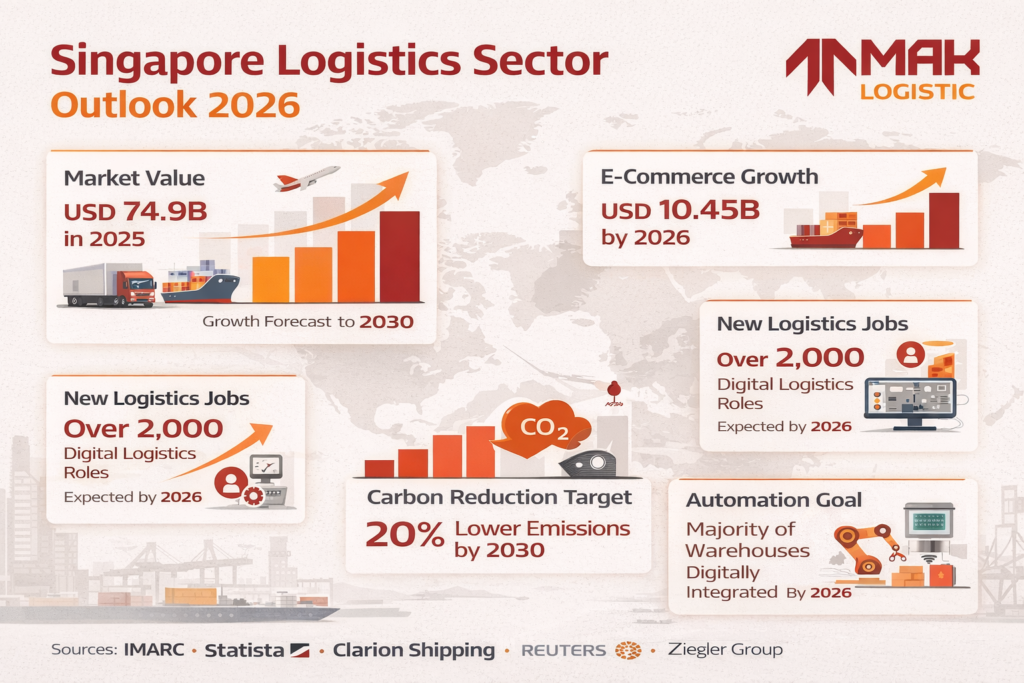
Key statistics and growth projections for Singapore’s logistics sector, reflecting 2026 market, sustainability, and workforce trends.
Making Logistics Greener and More Sustainable
A major ambition for 2026 is to embed sustainability at every level of logistics operations.
Freight transport and logistics currently account for up to 8% of global greenhouse gas emissions, according to Reuters. Singapore’s logistics sector aims to reduce its carbon footprint through cleaner energy, optimized operations, and green innovation.
Key sustainability goals for 2026 include:
- Widespread adoption of electric and hybrid delivery fleets.
- Use of AI route optimization to cut fuel consumption.
- Deployment of solar-powered logistics hubs and energy-efficient warehouses.
- Greater emphasis on recyclable packaging and circular logistics.
The Singapore Green Plan 2030 and Maritime Decarbonisation Blueprint are providing the foundation for these initiatives, helping logistics operators transition toward net-zero supply chain operations.
Building a Digitally Skilled and Future-Ready Workforce
Singapore’s logistics ambitions cannot be achieved without its people.
By 2026, the goal is to build a highly skilled, digitally fluent logistics workforce capable of managing automation, analytics, and sustainability systems.
According to Clarion Shipping’s Workforce 2026 Study, over 2,000 new digital logistics roles are expected to emerge by 2026, particularly in AI operations, data engineering, and smart infrastructure management.
Government initiatives such as SkillsFuture Singapore and the Industry Digital Plan (IDP) for logistics are supporting:
- Continuous upskilling in data analytics and automation.
- Training in sustainable logistics practices.
- Workforce adaptation to robotics and IoT environments.
This human capital development ensures that the logistics workforce grows alongside technological progress, keeping Singapore globally competitive.
Strengthening Supply Chain Resilience and Risk Management
The logistics sector’s 2026 goal isn’t only about growth — it’s also about resilience.
After global disruptions like the pandemic, supply chain blockage, and energy crises, logistics providers are now focusing on stability, visibility, and risk prevention.
The Singapore Logistics Association (SLA) has been at the forefront of developing risk management frameworks and digital exchange platforms that improve collaboration and transparency across the supply chain.
By 2026, resilience objectives include:
- Diversifying global sourcing networks.
- Establishing predictive risk analytics to identify vulnerabilities.
- Enhancing real-time visibility with IoT sensors and cloud tracking.
A resilient supply chain means fewer disruptions, faster response times, and better customer satisfaction — all critical in a fast-moving global market.
Empowering E-Commerce and Last-Mile Innovation
The e-commerce boom is reshaping logistics priorities across Southeast Asia, and Singapore is no exception.
According to Statista, the Singapore e-commerce market is expected to reach USD 10.45 billion by 2026, growing at a compound annual rate of 8.7%.
This growth pushes logistics providers to focus on:
- Last-mile delivery optimization through smart route planning.
- Same-day and on-demand delivery services in urban zones.
- Automated fulfilment centers integrated with AI.
- Efficient reverse logistics for returns and recycling.
Singapore’s advanced infrastructure — from Tuas Mega Port to Changi Air Cargo Hub — enables it to become a regional fulfillment powerhouse, serving e-commerce players across the Asia-Pacific region.
Boost Customer Experience and Reduce Service Cost
By 2026, logistics providers are focusing heavily on customer-centric service delivery. With rising expectations for speed, transparency, and sustainability, companies are turning to digital tools that improve experience while reducing costs.
Key initiatives include:
- Real-time order tracking and visibility.
- AI-driven customer support and chatbots.
- Predictive analytics for smoother delivery scheduling.
- Process automation to reduce manual errors.
These innovations allow logistics companies to deliver greater satisfaction while improving cost efficiency — a dual advantage critical to long-term growth.
Keep Drivers Happy Amid Labor Shortages
The logistics sector also faces a labor shortage, particularly in last-mile delivery and freight operations.
To address this, companies are improving working conditions and leveraging automation to ease workloads.
Strategies include:
- Competitive pay and incentive programs.
- Safer, more comfortable vehicles with assistive technologies.
- Flexible work schedules.
- Introduction of electric fleets that simplify driving and reduce fatigue.
A happier, better-supported workforce directly translates into improved service quality and higher customer retention.
Optimizing Last-Mile Delivery Costs
The final stretch of delivery remains the most costly part of logistics operations, accounting for nearly 53% of total shipping expenses.
To address this, Singapore’s logistics firms are using a combination of technology and planning to make last-mile delivery more efficient.
Optimization strategies include:
- Deploying micro-fulfilment centers closer to consumers.
- Using AI for route optimization and traffic prediction.
- Implementing shared delivery networks to maximize vehicle utilization.
- Exploring autonomous and drone delivery pilots.
These innovations are central to achieving cost efficiency and faster turnaround times — both critical goals for 2026.
Conclusion
As Singapore’s logistics sector moves toward 2026, its focus on digital transformation, sustainability, workforce empowerment, and resilience is setting new global standards.
The country’s commitment to innovation, supported by public–private collaboration, ensures that Singapore remains at the forefront of global trade efficiency.
At MAK Logistic, we share this vision — driving smarter, greener, and more customer-focused logistics solutions that reflect the evolving needs of our clients and the global marketplace.
Together, we’re helping shape a connected, efficient, and sustainable logistics future for Singapore and beyond.